
Table of Contents
- Do You Actually Need an SEO Agency?
- When Hiring an Agency Makes Sense?
- When Hiring an Agency Does Not Make Sense
- What You’re Really Buying When You Hire an SEO Agency?
- Agency vs In-House vs Consultant vs Freelancer
- How to Evaluate an SEO Agency Without Getting Distracted?
- Questions to Ask an SEO Agency Before Hiring
- Red Flags that Lead to Wasted Retainers
- How Hiring Criteria Changes by Business Type
- What a Good SEO Agency Should Show You Early
- Final Hiring Framework
- Conclusion
Most businesses approach hiring an SEO agency as a selection problem.
They compare providers. They review proposals. They ask for case studies. They try to identify the “best” option.
That approach misses the real decision.
Hiring an SEO agency is not primarily about choosing between vendors. Hiring an SEO agency is about deciding whether your business needs external execution capacity to grow through search.
If you get that part wrong, the agency choice does not matter much. If you get that part right, the selection process becomes clearer and more practical.
Do You Actually Need an SEO Agency?
Not every business needs an SEO agency.
Some businesses need clarity. Some need time. Some need better fundamentals. Some need a different channel entirely.
The question is not “should we hire an agency.” The question is “what is stopping our organic growth right now.”
Most SEO bottlenecks fall into a few categories.
1. No clear strategy
The team does not know what pages to build, what keywords matter, or how search demand connects to the product or service.
In this case, the problem is direction.
A founder or marketing lead often feels this as confusion. Work gets done, but it does not connect to outcomes.
2. Not enough production
The team knows what to do but cannot produce enough content, pages, or supporting assets to compete.
In this case, the problem is volume.
The site stays small while competitors expand.
3. Weak authority
The site has content, but it does not rank because competitors have stronger backlink profiles and brand signals.
In this case, the problem is strength.
The pages exist but do not win.
4. Lack of consistency
The team works in bursts. Work gets done in phases. Then it stops.
In this case, the problem is rhythm.
SEO requires sustained execution. Stop-start work breaks momentum.
When Hiring an Agency Makes Sense?
Hiring an SEO agency makes sense when your internal team cannot solve one or more of those constraints efficiently.
A simple way to think about it:
- If you lack direction, you need strategy
- If you lack output, you need production
- If you lack authority, you need external amplification
- If you lack consistency, you need a system
An agency should provide one or more of those at a level your team cannot match internally.
When Hiring an Agency Does Not Make Sense
Hiring an agency often fails in these situations:
- The business model is not validated yet
- The product or service does not convert
- The team expects fast results in a competitive market
- The budget does not support meaningful output
- The company is not ready to support content or approvals
SEO amplifies what already works. It does not fix a broken offer.
A useful way to understand is thinking about fuel.
SEO acts like fuel in a system. If the engine works, fuel increases output. If the engine fails, fuel does not fix it.
What You’re Really Buying When You Hire an SEO Agency?
Most businesses believe they are buying expertise.
In practice, they are buying capacity.
That capacity includes strategic thinking, content production, authority development, technical implementation, and ongoing execution. The important detail is not the list itself. The important detail is that these functions need to work together over time.
A business that hires an agency is not outsourcing a task. It is installing a system.
That system should expand the site, strengthen its ability to rank, and maintain forward movement.
Think of a manufacturing line.
A factory does not produce output because it owns tools. A factory produces output because it has a system that uses those tools in a repeatable way.
SEO works the same way. The tools matter less than the system that uses them.
If an agency cannot operate as a system, it will default to isolated activities. Those activities may look productive. They rarely produce sustained growth.
Think in systems, not services
A weak mental model is:
“We need keyword research, some content, and some links.”
A stronger model is:
“We need a system that expands our site, strengthens it, and maintains growth over time.”
The difference is similar to hiring a chef versus building a kitchen.
A chef can cook a meal. A kitchen allows you to produce meals continuously.
A strong SEO agency builds and operates the equivalent of that kitchen.
Agency vs In-House vs Consultant vs Freelancer
This decision shapes outcomes more than most businesses expect.
Each option solves a different problem, and confusion here leads to poor hiring decisions.
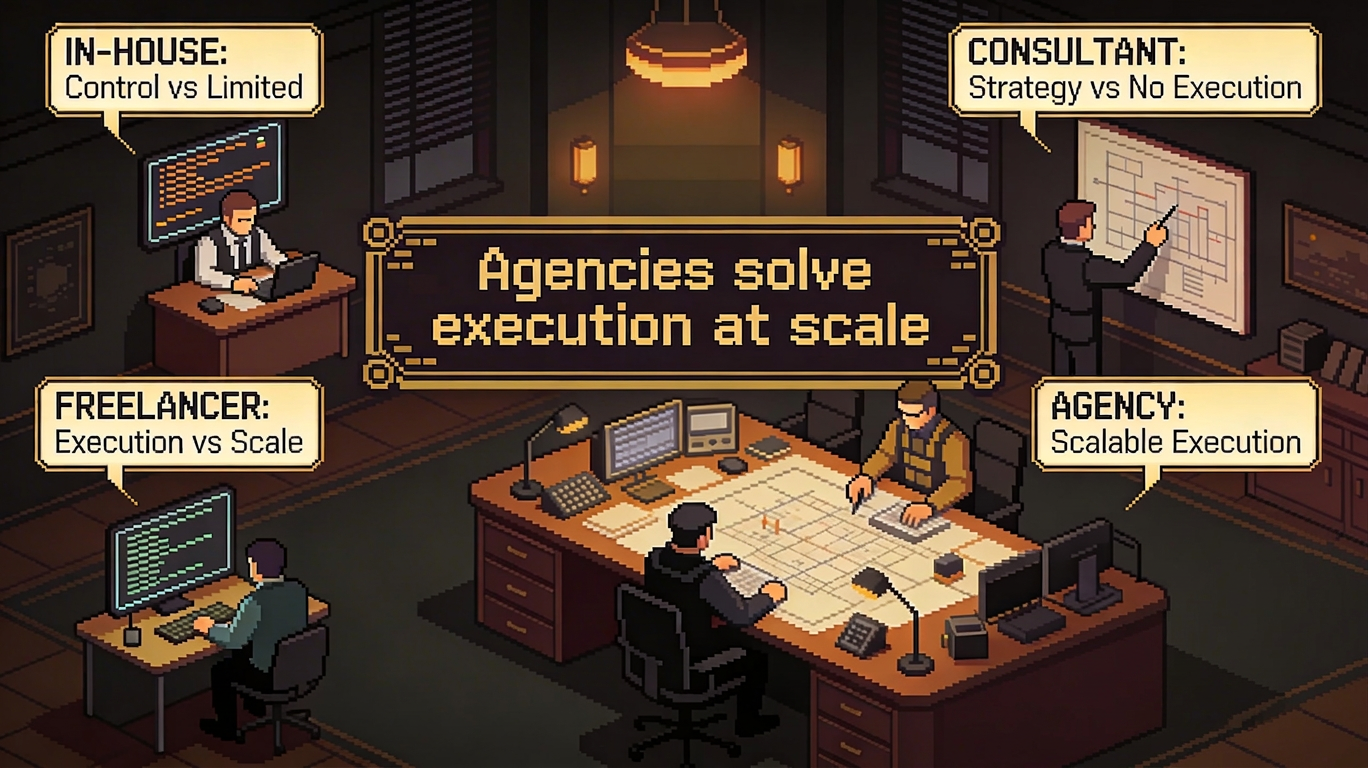
An in-house hire works best when the company wants long-term capability embedded inside the business. The advantage is alignment and control. The limitation is coverage. One person rarely covers strategy, production, authority, and technical work at a high level simultaneously.
A freelancer works well when the business already has direction and needs help executing a specific task. The limitation is scale. Freelancers tend to be narrow in scope and require coordination.
A consultant works well when the business needs clarity and direction but can execute internally. The limitation is obvious. Advice does not create output unless the team has the capacity to implement it.
An agency works best when the business needs execution across multiple areas at once and needs that execution to be consistent.
The simplest way to frame it is this.
If your problem is knowing what to do, you need strategy. If your problem is getting it done at scale, you need execution.
Agencies exist to solve the second problem.
How to Evaluate an SEO Agency Without Getting Distracted?
Most businesses evaluate agencies using visible signals.
They look at case studies, testimonials, and presentation quality. These signals reduce perceived risk. They do not predict performance.
A stronger approach focuses on operational capability.
The first question is whether the agency can define what it will build. A serious agency should be able to describe the types of pages your business needs and how those pages connect to demand. If the answer remains abstract, the strategy is incomplete.
The second question is whether the agency can describe scale. SEO requires volume relative to the market. A credible agency should be able to estimate how much needs to be built and at what pace.
The third question is whether the agency can connect work to outcomes. Pages should lead to visibility. Visibility should lead to traffic. Traffic should connect to leads or revenue. If that chain is unclear, the work will drift.
The fourth question is whether the agency can describe the future state of your site. Ask what your website will look like in six months. A strong agency should describe structure, coverage, and direction in concrete terms.
This question works because it forces the agency to think in systems rather than tasks.
Questions to Ask an SEO Agency Before Hiring
The goal of asking questions is not to test knowledge.
The goal is to understand how the agency operates, how it makes decisions, and whether it can actually build what your business needs.
Good agencies will answer clearly. Weak agencies will stay abstract.
What will you build in the first 3 to 6 months?
This is the most important question.
You are not looking for a vague answer about improving SEO. You are looking for a description of output.
A strong answer should include page types, structure, and scope. For example, service pages, location pages, comparison pages, or category expansions.
This question reveals whether the agency operates with a production model or an activity model.
How do you decide what to prioritise?
SEO is not a list of tasks. SEO is a sequence of decisions.
The agency should explain how it evaluates:
- demand
- competition
- business value
- ranking feasibility
If the answer is limited to “keyword research,” the thinking is shallow.
You want to understand how decisions get made, not just what tools get used.
How much content or how many pages will you produce monthly?
SEO requires scale relative to the market.
The agency does not need to promise a fixed number, but it should give a realistic range and explain how that changes based on competition and budget.
If there is no discussion of volume, there is no discussion of growth.
How do you approach link building and authority?
Authority determines whether your pages rank.
The agency should explain how it strengthens the site over time.
You are not looking for trade secrets. You are looking for clarity that authority is part of the system, not an afterthought.
What will success look like in 6 months?
This question shifts the conversation from promises to structure.
A strong agency will describe progress in terms of:
- site expansion
- improved coverage
- stronger internal linking
- initial authority growth
They will not rely only on rankings or traffic projections.
What do you need from our team?
SEO does not happen in isolation.
Content approvals, product knowledge, access, and alignment all affect execution.
A good agency should explain what it needs from you so the system runs smoothly.
How do you adapt your strategy to our business model?
A local business, a SaaS company, a B2B firm, and an ecommerce store require different structures.
The agency should explain how your model changes what gets built and prioritised.
If the answer sounds identical for every business, the strategy is not tailored.
Red Flags that Lead to Wasted Retainers
Some patterns appear repeatedly in underperforming SEO engagements.
These are not theoretical risks. These are common failure points.
The agency cannot define output
If the agency cannot explain what it will build, it cannot be accountable for progress.
SEO requires visible production. Without that, work turns into maintenance.
The strategy focuses heavily on technical SEO alone
Technical SEO improves infrastructure.
Infrastructure supports growth, but it does not create demand on its own.
If content and authority are missing, technical work has limited impact.
The plan does not include a production model
A strong SEO campaign expands the site.
If there is no clear plan for new pages, new sections, or new coverage, the campaign will stall.
The same strategy is applied to every business
SEO systems should reflect the business model.
Local, SaaS, B2B, and ecommerce require different structures.
A one-size-fits-all approach signals weak strategic thinking.
Reporting replaces execution
Reports should reflect what has been built and improved.
If reporting becomes the main deliverable, the campaign is not producing enough output.
The agency avoids discussing scale
If the agency avoids conversations about how much work is required, it avoids accountability.
Growth depends on volume and consistency.
Without that discussion, expectations will not match reality.
How Hiring Criteria Changes by Business Type
This is where most guidance becomes too general to be useful.
Different business models require different SEO systems, and the hiring decision should reflect that.
Local businesses
A local business grows by capturing demand tied to both service and location. The structure of the site needs to reflect how people search for services in specific areas.
A strong agency in this space focuses on building service pages and location pages that work together. It also understands how local authority signals support organic rankings and conversions.
A useful way to think about this is territory.
Each page represents a part of the market you can reach. If that territory is not covered, demand exists but remains inaccessible.
SaaS businesses
A SaaS company grows by capturing evaluation intent.
Potential customers search for features, alternatives, comparisons, and use cases. The site needs to support those search behaviours.
A strong agency builds pages that mirror the buying process. Some pages introduce the product. Some pages compare it. Some pages help users understand specific use cases.
This structure works like a guided path. Each page helps move a potential customer closer to a decision.
B2B businesses
B2B search tends to reward specificity.
Buyers often search for solutions to defined problems within a particular industry or context. The site needs to demonstrate understanding and credibility.
A strong agency focuses on building pages that align with industries, problems, and outcomes. These pages act as signals of expertise.
The goal is not just visibility. The goal is recognition from the right audience.
Ecommerce businesses
Ecommerce growth depends heavily on structure.
The site needs to cover product categories, subcategories, and related search demand in a way that is both navigable and indexable.
A strong agency understands how to expand category coverage and support it with internal linking and relevant content.
A useful analogy is retail space.
The more organised and complete your product layout is, the easier it becomes for customers to find what they want.
What a Good SEO Agency Should Show You Early
A strong agency should not wait six months to demonstrate value.
Early indicators include:
- clear structure plan
- defined page roadmap
- visible production output
- initial authority work
- alignment with business goals
You should see movement in what is being built, even if rankings take time.
Final Hiring Framework
The decision becomes clearer when you treat it as a structured process rather than a vague comparison.
Step 1: Identify the constraint
Your business should define what is limiting growth.
That limitation may be strategy, production, authority, or consistency.
Without clarity here, the hiring decision will be unfocused.
Step 2: Decide if the constraint can be solved internally
Your team should evaluate whether it has the time, skill, and capacity to solve the problem.
If the answer is no, external support becomes necessary.
Step 3: Choose the right model
The business should select the model that matches the problem.
A consultant solves direction. An agency solves execution. A freelancer solves specific tasks. An in-house hire builds long-term capability.
Step 4: Evaluate execution capacity
The provider should demonstrate the ability to build what is required.
This includes pages, structure, and authority support.
You are not evaluating promises. You are evaluating capability.
Step 5: Align budget with output
SEO output depends on resources.
The business should ensure the budget supports the level of execution required to compete.
A mismatch here leads to slow or stalled progress.
Step 6: Validate the system
Before committing, the business should confirm that the agency operates as a system.
The agency should be able to explain:
- what gets built
- how often it gets built
- how it connects to outcomes
If that system is clear, the decision becomes straightforward.
Conclusion
Hiring an SEO agency is not a decision about marketing tactics.
Hiring an SEO agency is a decision about how your business builds and maintains its presence in search.
That distinction matters because most failures do not come from choosing the wrong agency. Most failures come from misunderstanding what needs to be built in the first place.
A business that lacks coverage will not grow without more pages.
A business that lacks authority will not compete without stronger signals.
A business that lacks consistency will not gain momentum over time.
An agency should solve one or more of those constraints in a structured way.
That is the standard.
If an agency cannot explain what it will build, how it will build it, and how that work connects to your business, the outcome will remain uncertain.
If an agency can define the system clearly, show how it adapts to your model, and execute consistently, the decision becomes straightforward.
At that point, you are no longer choosing based on presentation.
You are choosing based on production capacity.
That is what determines whether SEO becomes a meaningful growth channel or another stalled initiative.
The right agency does not just improve your website.
The right agency builds the structure that allows your business to be discovered, evaluated, and chosen.