
B2B SEO: The Framework for Driving Pipeline, Revenue, and Long-Sales-Cycle Growth
What This Guide Covers
- B2B keyword research prioritized by pipeline value
- Funnel mapping across buyer journey stages
- Page types and content architecture
- Internal linking systems that drive authority
- Content operations and editorial workflow
- SEO pipeline attribution models
- Sales alignment and account-based SEO
- Enterprise and international scaling
B2B SEO is the process of making your website, commercial pages, and content visible to business buyers at every stage of their purchase journey: from problem discovery to vendor selection.
The difference from B2C is structural, not algorithmic. B2B SEO targets lower-volume, higher-intent searches across sales cycles that average 84 days, with buying committees where 11 stakeholders conduct independent research before any deal closes. The keywords are narrower, the content requirements are deeper, and the conversion path runs in months, not sessions.
What Is B2B SEO?
Understanding the practice of earning organic visibility for business buyers at every stage of their research.
B2B SEO is the practice of earning organic visibility in search engines and AI-generated responses for the queries business buyers use at each stage of their research. The goal is not traffic. The goal is a qualified pipeline from buyers actively trying to solve a problem your company solves.
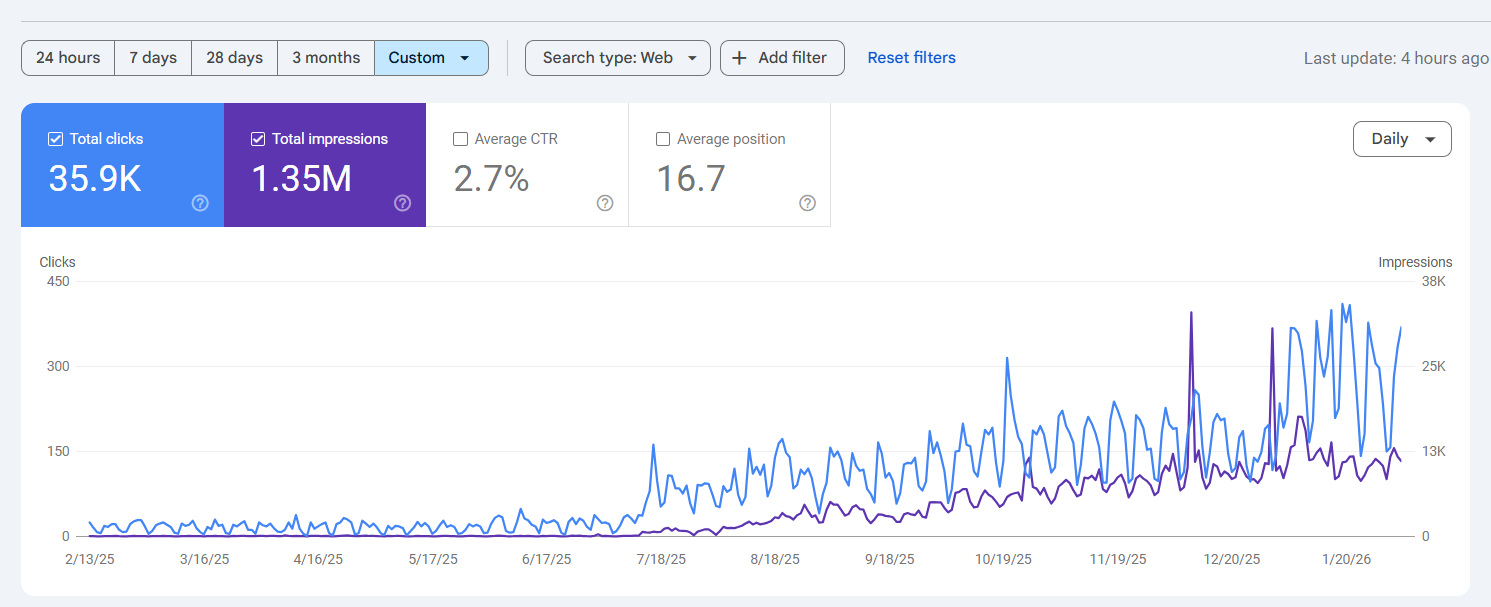
Three things separate B2B SEO from other forms of search optimization:
Pipeline value, not volume, is the priority metric.
A keyword with 50 monthly searches is not automatically low-priority.
If those 50 searchers are CFOs evaluating a six-figure purchase, that traffic is worth more than 50,000 visitors with no buying intent. B2B SEO that uses B2C volume logic consistently underfunds the most commercially valuable content.
Search surfaces have multiplied.
B2B buyers now find vendors through Google results, AI Overviews, Perplexity, ChatGPT, and Reddit threads. Optimizing only for the ten blue links misses a growing share of early-stage discovery. A complete program builds presence across all surfaces where buyers research.
Every buyer stage requires different content.
B2B buyers conduct 12 to 14 searches across four to six sites before contacting a vendor. They start by understanding a problem, move to evaluating solution categories, and end by comparing specific vendors.
A program that only addresses one of those stages is invisible during the rest.
Why B2B SEO Works Differently from B2C
The gap is in the buying process, not the algorithm.
The gap between B2B SEO and B2C SEO is not the algorithm. Google applies the same ranking factors to both. The gap is in the buying process that those algorithms serve.
In B2C, one person makes a quick decision. In B2B, 11 people make a slow one. A single product page can convert a B2C first-time visitor.
In B2B, that same page serves one stakeholder in a committee of many.
The result: a B2B SEO program looks less like a blog and more like a structured information architecture built to answer every question every stakeholder will ask before signing a contract.
How B2B Buyers Find Vendors Today
AI-assisted research is now standard.
Approximately 89% of B2B buyers use generative AI at some stage of their purchase journey, according to Demand Gen Report. Traditional search engines have grown in their share of internet visits year over year, but buyers increasingly receive summarized answers before visiting any website.
Content must be structured to appear inside those summaries, not only in the organic results below them.
Zero-click search reduces raw traffic returns.
Roughly 60% of Google searches end without a click, according to Pew Research Center. AI Overviews appear in approximately 30% of results pages. B2B SEO is increasingly about brand exposure and shortlist position, not just earning a click.
Buyers finish most of their research before sales enters.
B2B buyers complete 57 to 70% of their research before speaking with a salesperson. Your content is covering ground that an SDR used to cover in discovery calls. If your organic presence is thin, competitors are answering those questions instead.
What a Complete B2B SEO Program Covers
A B2B SEO program has six components, each dependent on the one before it:
| Component | What It Does |
|---|---|
| Technical foundation | Crawlability, indexation, site architecture, Core Web Vitals |
| Keyword and demand mapping | Pipeline-prioritized keyword sets organized by intent and persona |
| Content architecture | Page types assigned to intent clusters, built around topic hubs |
| Internal linking | Authority flow from informational pages to commercial pages |
| Link acquisition | Backlinks from industry publications, partners, and original research |
| Measurement and attribution | Organic sessions connected to pipeline and revenue via CRM |
Why B2B SEO Generates Pipeline
The ROI and CAC Case
Average B2B SEO ROI is approximately 756%, compared to approximately 362% for paid search. Customer acquisition cost from organic averages around $276, versus approximately $1,215 from paid search.
SEO-generated leads close at 14.6%, nearly double the rate of outbound-generated leads, because buyers who find you through search have self-identified as someone actively trying to solve a problem.
Paid search stops the moment budget stops. Organic search builds an asset. A page that ranks today generates leads for months or years without additional spend.
Over a 24-month horizon, the cost per SQL from organic consistently falls while paid costs hold flat or increase. That compounding difference is the budget argument for SEO that paid search can never make.
How the Buying Committee Shapes Content Requirements
An enterprise B2B purchase involves an average of 11 stakeholders. The CFO needs ROI data and total cost of ownership models. The IT team needs security documentation and integration specifications. The practitioner needs workflow comparisons and feature depth.
Procurement needs vendor qualifications and compliance records.
A B2B company with content gaps across those stakeholder types is invisible to part of every buying committee evaluating them. A company invisible to part of the committee cannot make the final shortlist.
SEO as a Category Trust Signal
Consistent organic presence across the topics your buyers research creates a trust signal paid media cannot replicate. Decision-makers notice when a vendor consistently shows up when they search problems they care about.
That accumulated visibility signals category investment before the first sales conversation starts.
B2B SEO vs. B2C SEO
The structural differences that determine metrics, content, and measurement.
The differences between B2B and B2C SEO determine which metrics to optimize for, what content to build, and how to measure success. The table captures the structural gap; the subsections explain why each difference changes how you operate.
| Dimension | B2B | B2C | What It Changes |
|---|---|---|---|
| Average sales cycle | 84 days | 9 days | Content must nurture across months, not sessions |
| Decision makers | 11 stakeholders | 1 to 2 people | Content must serve multiple personas simultaneously |
| Keyword volume | 3 to 5x lower | Higher | Success measured by pipeline influence, not traffic |
| Intent signal | Rational, ROI-driven | Emotional, price-driven | Commercial content must prove value with numbers |
| Content before purchase | 13 pieces | 3 to 5 pieces | Depth and cluster breadth create competitive advantage |
| Organic conversion rate | ~2.1% | ~3.3% | Nurture and retargeting must extend the funnel |
How Keyword Strategy Differs
In B2C, volume-first keyword research makes sense. In B2B, that logic fails.
A keyword with 50 monthly searches that maps to a $200,000 deal is worth more investment than one with 10,000 searches from buyers who will never purchase. CPC data from Google Ads is the most reliable proxy for commercial value: when advertisers bid $20 to $40 per click, they have demonstrated through real spend that the traffic converts.
Approximately 70 to 80% of B2B searches are non-branded long-tail queries of three or more words. A proper B2B keyword research process starts by identifying what buyers search at each stage of the journey, not by building a list sorted by monthly search volume.
How the Conversion Path Differs
B2C SEO optimizes the product page and checkout flow. B2B SEO requires a more complex page architecture: educational content builds category authority, solution pages capture commercial intent, comparison and alternative pages intercept BOFU evaluation queries, and case studies provide proof that finalizes vendor selection. Each page type serves a different stage and a different stakeholder.
Understanding how those page types map to the B2B SEO funnel is what separates programs that generate pipeline from ones that generate traffic.
How Attribution Differs
B2C attribution is relatively clean: click, purchase, done. B2B attribution spans months and multiple people. A buyer who finds you through a TOFU blog post in January, returns for a comparison page in March, and books a demo in May touched three organic assets across three months.
Last-click attribution credits only the demo page. Multi-touch attribution credits all three. Configuring SEO pipeline attribution correctly is often what changes B2B SEO from an underfunded cost center to a fully credited revenue channel.
How B2B Buyers Search Before They Buy
Understanding search behavior across the buyer journey stages.
This section covers search behavior: what queries buyers use and why. The next section covers which content formats and page types correspond to each stage. They do different jobs.
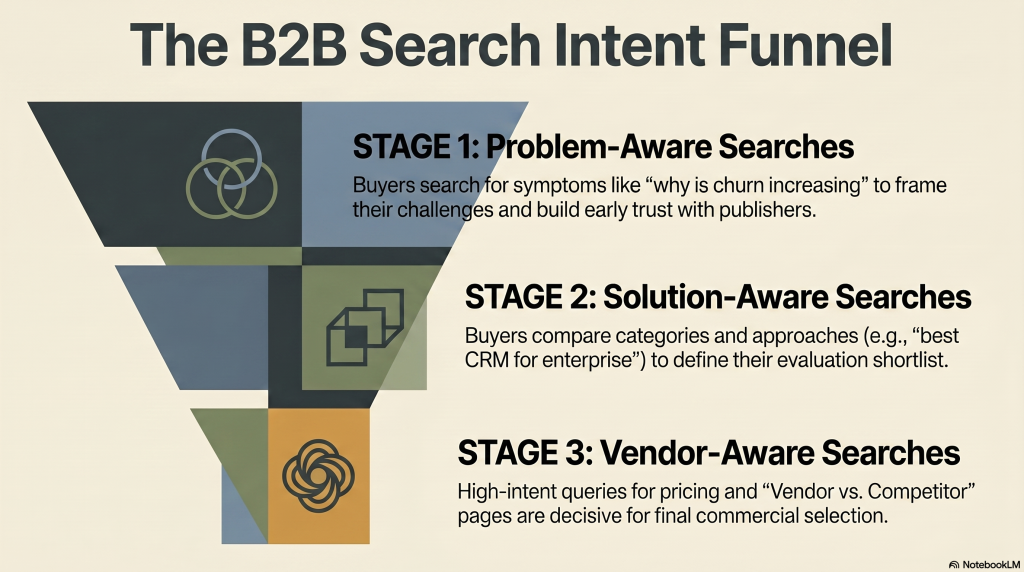
Problem-Aware Searches
At the earliest stage, buyers are not looking for a product. They are framing a problem. Queries are symptom-led: “why is our customer churn increasing,” “how to improve sales cycle velocity,” “B2B pipeline forecasting problems.”
Content that earns attention here, explaining the problem with precision and depth, positions that publisher as the credible starting point for the rest of the research journey.
That early trust carries significant weight when the buyer reaches vendor selection.
Solution-Aware Searches
The buyer now has a working hypothesis about the solution type they need. They search for categories and approaches: “revenue intelligence software comparison,” “best CRM for enterprise sales teams,” “how B2B data enrichment works.”
Classifying the underlying B2B search intent behind each query is critical here, because the same topic can require fundamentally different content depending on whether the buyer is framing a problem or comparing solutions.
Earning placement at this stage directly shapes whether your brand appears on the evaluation shortlist.
Vendor-Aware Searches
The buyer has narrowed to a short vendor list and is in active comparison mode.
Queries become specific: “[Vendor] pricing,” “[Vendor] vs. [Competitor],” “[Vendor] case studies financial services,” “[Vendor] SOC 2 compliance.”
This is where comparison pages, alternative pages, pricing pages, and proof assets are decisive. A company without dedicated content for these queries loses deals during the final evaluation stage, often to competitors whose pages simply answer the questions the buyer is asking.
The commercial selection intent section below maps every query pattern at this stage.
How Different Stakeholders Search
The same deal has multiple stakeholders searching simultaneously for different things. A B2B SEO program that addresses only one stakeholder type reaches a fraction of each buying committee.
| Stakeholder | Search Behavior | Content That Serves Them |
|---|---|---|
| Practitioner | Feature comparisons, workflow guides, integration questions | Product pages, how-to content, integration docs |
| Manager | Team ROI, adoption benchmarks, implementation timelines | Use-case pages, case studies, ROI calculators |
| Economic buyer (CFO/VP) | Total cost of ownership, ROI models, risk | Pricing pages, ROI content, security documentation |
| Technical evaluator (IT/CTO) | Security, APIs, integration specs, compliance | Technical documentation, integration pages |
| Procurement | Vendor qualification, compliance, contract terms | Trust pages, compliance certifications |
The Role of Branded, Non-Branded, and Comparative Queries
Non-branded queries dominate the early funnel and represent 70 to 80% of all B2B searches. Branded queries rise at the decision stage as buyers validate their shortlist.
Comparative queries (“HubSpot vs. Salesforce”) carry some of the highest purchase intent in all of B2B search, typically signaling a buyer who has done substantial research and is ready to evaluate specific vendors head-to-head.
A complete B2B Search Engine Optimization program has a deliberate strategy for all three query types.
The Core B2B SEO Framework
Five foundational layers that build on each other systematically.
A B2B SEO framework runs on five layers. Each depends on the one before it. Skipping early layers to accelerate content production is the most common reason programs generate traffic that never becomes pipeline.
Demand Mapping
Before creating any content, map what buyers are searching for at each stage of their journey. This is the demand map: a complete picture of buyer intent across awareness, consideration, and decision stages, organized by persona.
Demand mapping starts with buyers, not keyword tools. Talk to sales. Listen to call recordings. Mine support tickets. Review win/loss notes. The language buyers use in sales conversations is what they type into search engines.
It is almost always different from the language the marketing team uses internally, and the gap between the two is exactly where keyword tools fail.
A practical starting point: ask sales for the ten questions every prospect asks before signing and the five objections that kill the most deals. Those fifteen items are the highest-priority content briefs in any SEO program.
Intent Mapping
Once you have the demand picture, classify every keyword cluster by intent type. Intent classification determines page type. Forcing the wrong format onto a keyword is the primary reason well-ranked B2B pages fail to generate pipeline.
| Intent Type | What the Buyer Is Doing | Page Type |
|---|---|---|
| Educational | Understanding a concept or problem | Guide, blog post, glossary |
| Comparative | Evaluating options or approaches | Comparison page, “best of” list |
| Commercial | Researching a specific solution or vendor | Product page, solution page |
| Transactional | Ready to act: demo, trial, pricing | Landing page, pricing page |
Page-Type Mapping
Every keyword cluster needs a designated URL before content creation begins. Mapping every priority cluster to a URL before production prevents two costly failures: publishing blog posts for queries that need product pages, and creating pages that compete with each other for the same query.
Building B2B topical authority at scale depends on this mapping being done before production starts. Without it, production decisions default to editorial preference rather than commercial priority.
Authority Building
Topical authority, meaning the signal that your site is the most credible and comprehensive resource on a given topic, is built through three mechanisms simultaneously: depth of content across the topic cluster, a structured internal linking architecture connecting related pages, and external backlinks from authoritative industry sources.
Authority compounds over time as the cluster grows, internal links accumulate, and external references stack. It is not built with a single piece of content and not maintained by publishing alone.
Measurement and Iteration
Rankings and traffic are diagnostic. They explain performance but not business impact.
The operational feedback loop in a B2B SEO program runs on pipeline data: organic-attributed SQLs, organic-sourced pipeline value, and revenue influenced by organic touchpoints.
These measurements feed back into the demand map quarterly to refine priorities and cut what attracts traffic without contributing to revenue. Building the B2B SEO forecasting model from this data is what converts SEO from an activity into a business investment with a measurable return.
B2B Keyword Research
Finding queries where buyers are close to a decision, not queries where many people are searching.
B2B keyword research is about finding queries where the buyer is close to a decision, not queries where many people are searching. The organizing principle is pipeline potential, not search volume.
How to Prioritize Keywords by Revenue Potential
Two data points reliably proxy for commercial value:
CPC (cost-per-click): When advertisers pay $20 to $40 per click, they have empirically demonstrated that traffic converts into revenue. High CPC with lower search volume is the classic B2B keyword pattern. Filter keyword sets for CPC of $5 or more as a minimum commercial threshold in most B2B categories.
Funnel stage: BOFU keywords convert at higher rates regardless of volume. A 50-search/month pricing or comparison keyword generates more SQLs than a 5,000-search/month educational keyword from the same topic cluster. Prioritize the BOFU layer of every cluster first, then build MOFU, then TOFU, in that order, even though it runs opposite to most content team instincts.
Six Seed Categories for a Complete Keyword Set
Build the keyword universe from these six categories rather than starting with a tool export:
Product and service terms target direct searches for what you sell. These are the commercial core: optimize them before any other content type.
Use-case terms describe the job the buyer needs to accomplish: “automate SDR prospecting,” “reduce time to close,” “enrich CRM data in real time.” These are where high-intent B2B keywords cluster most densely, with strong MOFU and BOFU signal.
Pain-point terms target symptom-led searches: “why is sales forecasting inaccurate,” “how to fix high churn,” “pipeline coverage below 3x.” These feed TOFU content and pull buyers into the cluster from early-stage searches.
Comparison and alternative terms target “[Competitor] alternative,” “best [category] software,” “[Your brand] vs. [Competitor].” These map to BOFU comparison and alternative pages, consistently among the highest-converting page types in B2B.
Industry and vertical terms target context-specific searches: “CRM for manufacturing,” “revenue intelligence for financial services,” “HR software healthcare.” These map to industry pages, one of the most underbuilt and highest-converting page types in B2B SEO.
Implementation and integration terms capture late-funnel buyers: “how to implement [category],” “[Product] Salesforce integration,” “[Category] onboarding timeline.” These buyers are past category evaluation and building an internal case for a specific vendor.
Which Keyword Patterns Signal Buying Intent
The highest-intent keyword patterns in B2B name a specific vendor or solution, include commercial modifiers, and reflect a buyer who has already done significant category research:
- “[Vendor] pricing” and “[Vendor] cost”
- “[Vendor] vs. [Competitor]”
- “Best alternatives to [Competitor]”
- “[Category] software for [specific industry]”
- “[Category] ROI” and “[Category] business case”
- “[Product] [CRM/platform] integration”
Each pattern needs a dedicated, optimized page. Sorting your keyword sets by these patterns before assigning page types is the core of a sound B2B search intent classification process.
How to Turn Keyword Clusters into a Page Plan
Every keyword cluster needs a designated URL as its primary page for that intent group. Mapping clusters to URLs before production prevents cannibalization (your own pages competing for the same query) and editorial drift (producing content based on what sounds interesting rather than what has pipeline potential).
The keyword-to-page map is the production backlog. Without it, production decisions default to editorial preference rather than commercial priority.
Choose the Right SEO Engagement Model
See the service models we use to turn B2B SEO strategy into execution, accountability, and measurable pipeline growth.
Mapping SEO to the B2B Buyer Journey
Aligning content formats and page types with each buyer stage.
This section covers what content formats and page types correspond to each buyer stage. For the search behavior at each stage, see How B2B Buyers Search Before They Buy above.
The B2B SEO Buyer Journey Matrix
| Funnel Stage | What Buyers Are Doing | Query Types | Best Formats | Conversion Goal |
|---|---|---|---|---|
| Top of Funnel | Identifying and framing a problem | Problem-identification, category education | Guides, original research, glossaries | Email capture, newsletter |
| Middle of Funnel | Comparing solutions, building shortlists | Category comparisons, use-case specificity, best-of lists | Solution guides, industry pages, frameworks | Demo request, sales conversation |
| Bottom of Funnel | Comparing vendors, building internal case | Vendor comparisons, alternative searches, pricing, proof | Comparison pages, alternative pages, pricing pages, case studies | Demo booked, trial, proposal |
| Commercial Selection | Ready to choose a vendor | “[Vendor] vs. [Competitor],” pricing, implementation, reviews, compliance | Dedicated comparison, alternative, pricing, security pages | Demo, contract |
Top-of-Funnel B2B Content
TOFU buyers are framing a problem, not evaluating vendors. Comprehensive definitional guides, original research reports, point-of-view content, and glossary pages earn attention at this stage by explaining the problem more clearly and precisely than anyone else.
The conversion goal is email capture: entering the buyer’s research orbit so you can re-engage when intent matures. TOFU content earns links and builds topical authority but rarely generates SQLs directly. Measure it on assisted conversions and influenced pipeline.
Building TOFU content that compounds into pipeline rather than just traffic is what the B2B thought leadership SEO and B2B blog strategy guides cover in full.
Middle-of-Funnel B2B Content
MOFU buyers are comparing solution approaches and building internal requirements. Solution guides organized by use case, industry-specific pages, “best [category]” content with genuine independent analysis, and framework content all serve this stage.
This is where most B2B SEO programs under-invest. Teams build TOFU blogs and BOFU product pages but leave the MOFU layer thin, which means they generate awareness but fail to capture buyers during the evaluation phase when shortlists form.
The full funnel framework covers MOFU architecture, content formats, and conversion paths in detail.
Bottom-of-Funnel B2B Content
BOFU buyers are comparing specific vendors, validating shortlists, and building internal business cases. Comparison pages, alternative pages, pricing pages, case study libraries, ROI calculators, and integration documentation serve this stage.
BOFU pages convert at the highest rate of any content type in B2B. A single well-built comparison or alternative page routinely generates more qualified pipeline than dozens of TOFU posts. Invest in them proportionally.
Commercial Selection Intent Pages
Commercial selection intent is the specific query behavior of a buyer who is ready to choose a vendor. It sits at the sharpest end of the BOFU stage and carries the highest conversion potential of any query type in B2B.
These are the patterns that signal commercial selection intent:
- Head-to-head comparisons: “[Your brand] vs. [Competitor]”: the buyer is actively comparing two specific vendors
- Alternative searches: “Best [Competitor] alternatives”: the buyer is dissatisfied or deliberately avoiding a category default
- Pricing and investment: “[Vendor] pricing,” “how much does [category] cost”: the buyer is building a budget case internally
- Implementation and timeline: “[Vendor] implementation,” “how long does [category] take to deploy”: the buyer is operationalizing a vendor choice
- Reviews and validation: “[Vendor] G2 reviews,” “[Vendor] Gartner”: the buyer is seeking peer confirmation
- Security and compliance: “[Vendor] SOC 2,” “[Vendor] GDPR compliance”: IT or legal is running due diligence
- Integration specifics: “[Vendor] Salesforce integration,” “[Vendor] HubSpot compatibility”: the technical evaluator is vetting fit
Every one of these patterns needs a dedicated, optimized page. If you do not own this content, third-party review sites or your competitors do, and they are controlling the buyer’s final evaluation narrative. Prioritizing and sequencing these pages is what the high-intent B2B keywords guide covers in full.
The Highest-Impact Page Types for B2B SEO
Where most programs over-invest in blogs and under-invest in commercial pages.
Most B2B SEO programs over-invest in blog content and under-invest in commercial page types. That is the structural reason programs generate organic traffic without generating pipeline.
The page types below are listed in rough order of direct pipeline impact. For software companies where the product itself creates searchable use cases, product-led SEO for B2B explains how templates, tools, and product experiences can become the acquisition path.
Comparison Pages
Build a dedicated comparison page for each competitor where you can credibly win the evaluation. These pages capture buyers at the final vendor selection stage, generating some of the highest-converting traffic in all of B2B search.
Be honest: acknowledge where competitors are stronger before making the case for where you are the better fit. One-sided comparison pages convert poorly because buyers distrust them.
Alternative Pages
“[Competitor] alternatives” and “best alternatives to [Competitor]” capture buyers who are dissatisfied with their current solution or are deliberately avoiding the category incumbent. These buyers are typically at high urgency with a short evaluation timeline.
Alternative pages for the right competitive terms generate some of the fastest pipeline in B2B SEO.
Pricing Pages
B2B buyers research pricing before they speak to sales, even when pricing is custom or complex. A pricing page does not need a fixed number.
It should explain the pricing model, what factors influence cost, and what a typical investment looks like at different scales. A well-built pricing page pre-qualifies leads, reduces friction in sales conversations, and captures buyers who are not yet in active sales engagement.
Product and Service Pages
Every product or service needs a dedicated, optimized page. The most common failure: product pages written entirely in feature language with no search-intent alignment for a buyer still in solution evaluation mode.
Write every product page to simultaneously satisfy a buyer searching for the solution category and convert one who has already identified you as a candidate.
Industry Pages
If you sell to multiple verticals, each needs its own page. A practitioner who lands on a page built for their specific industry converts at significantly higher rates than one landing on a generic product page.
Industry pages rank for vertical-specific queries that attract buyers inside your ICP and double as sales enablement assets for account-based outreach.
Use-Case Pages
Use-case pages target job-to-be-done queries from mid-funnel buyers: “automate SDR prospecting,” “enrich CRM data in real time,” “reduce sales cycle length.” They often rank for long-tail queries with high commercial intent and low competition, because most competitors optimize at the category level and miss the use-case layer entirely.
Case Study Pages
Organize case studies by industry, company size, use case, and business outcome, not by company name or publication date. That organization maximizes both SEO relevance for specific buyer queries and sales utility for specific accounts in active outreach.
Statistics and Data Pages
Statistics pages aggregate current data for your category and attract backlinks from journalists, analysts, and other content creators.
Every external citation is a backlink earned without outreach. A well-maintained statistics page for your category is one of the most efficient link acquisition assets in B2B SEO, and it supports the B2B SEO statistics layer of your cluster without requiring active outreach campaigns.
Glossary Pages
Glossary pages rank for early-funnel definitional queries and build topical authority across the full term set of your category.
They are efficient to produce in volume, serve as strong TOFU entry points, and create internal linking opportunities into deeper cluster content across every topic hub.
Thought Leadership Pages
Original research, proprietary frameworks, and genuine point-of-view content build brand authority and attract high-quality backlinks.
They are also increasingly decisive for AI citation: large language models preferentially cite original research and expert analysis over generic informational content. Being the source cited inside an AI Overview carries meaningful visibility when those summaries appear before organic results.
This is what the B2B thought leadership SEO guide builds toward.
B2B Internal Linking
The most underutilized mechanism that turns individual pages into a compounding authority engine.
Internal linking is the most underutilized mechanism in B2B SEO. Most programs add a few related article links at the bottom of a post and stop there.
When executed with discipline, internal linking turns a collection of individual pages into a compounding authority engine that consistently pushes commercial pages.
Pillar-to-Cluster Architecture
The core internal linking model in B2B SEO is the pillar-cluster structure. Hub pages cover broad topics comprehensively and target competitive head terms.
Cluster pages go deep on specific subtopics and target narrower queries. Links flow bidirectionally: hub pages link to relevant cluster pages; cluster pages link back to the hub and to each other where topically adjacent.
Topic cluster strategies deliver approximately 325% average ROI with 3x organic traffic growth in 6 to 12 months, according to HubSpot research. Pillar pages rank 2.5x faster and drive 60% more traffic uplift than standalone content.
The mechanism is a coherent authority signal from interconnected pages that individual standalone pages cannot produce alone. Designing this structure before building content, which is what a B2B website architecture process does, determines how efficiently each new page you publish compounds into the cluster’s authority.
How to Link Informational Pages to Commercial Pages
The most impactful internal linking principle in B2B: every informational page must link strategically to the commercial pages it is conceptually connected to.
A guide on “how to reduce sales cycle length” links to the product page for the software that solves that problem.
A post on “B2B data enrichment best practices” links to the data enrichment solution page. A TOFU glossary entry links to the MOFU use-case page that goes deeper.
Buyers who move through those paths, from education to commercial consideration, are significantly more qualified than buyers who land on a commercial page cold. Build those paths deliberately, with every new piece of content published.
Intent-Progression Linking
Link by intent progression, not random topical adjacency.
A TOFU page links to the most natural next step for a buyer ready to go deeper into solution evaluation.
A MOFU page links to the BOFU pages most relevant for a buyer ready to compare vendors. Each internal link is the next step in a guided research path, not a related articles section.
Every new piece of content needs two types of internal links: backward links to the conceptual foundation the reader needs, and forward links to where a buyer naturally goes next.
Industry and Use-Case Hub Pages
Industry pages and use-case pages function as hubs for related content clusters. A “CRM for Manufacturing” page links to every relevant case study, blog post, comparison page, and use-case guide built for manufacturing buyers.
These hub pages concentrate topical relevance around a specific buyer context, which makes them effective at ranking for vertical-specific queries.
This pattern is especially important in enterprise Business-to-Business SEO programs, where multiple product lines and multiple regions each require their own hub structure.
Anchor Text and the Refresh Workflow
For links to commercial pages, use keyword-rich anchor text reflecting the target page’s primary search term. For links to informational pages, use natural descriptive language.
Vary across partial match, exact match, descriptive phrase, and next-step anchor. Avoid generic anchors (“click here”) and avoid over-optimized exact-match anchors on every link.
Simple habit that compounds: For every new page published, identify five existing pages that should link to it and five it should link to.
Update those ten pages within 48 hours of publication. That single habit, applied consistently, compounds into a meaningfully stronger authority architecture over 12 months than most dedicated link acquisition programs produce.
B2B Content Operations
Building a content operating system that maintains quality at scale.
The most common failure in B2B content marketing is scale without standards: teams publish more content, quality declines, search-intent alignment disappears, and the program generates traffic without pipeline.
The solution is not less content. It is a content operating system.
Briefing and Research Systems
Every piece of content starts from a detailed brief: primary keyword and intent classification, target persona, funnel stage, SERP analysis of what the top-ranking pages cover and where they fall short, key questions the content must answer, internal linking plan, conversion path, and SME or source requirement.
A brief is not a topic title and a word count. It is the full specification for a piece of content. Teams that brief at this level produce content that performs. Teams that brief at the topic level produce content that fails to rank and fails to convert, for predictable and preventable reasons.
SME Capture
The biggest competitive advantage in B2B content is genuine subject matter expertise. Generic content has become abundant. Content that reflects real practitioner knowledge, proprietary methodology, and original perspective cuts through because it cannot be replicated by a competitor with a content brief and an AI tool.
Build a workflow for capturing insights from your internal experts: a structured 30-minute interview template, a transcript-to-draft process that preserves the expert’s voice, and an editorial review that checks both accuracy and search-intent alignment.
The output should be content that only your company could have written.
Editorial QA
Every piece of content should clear five checks before publication:
Search intent alignment: Does this satisfy what the searcher is actually looking for, not what the team wants them to want?
Depth: Does this cover the topic more thoroughly than the current top-ranking pages?
Original value: Does this contain original data, genuine expert perspective, a proprietary framework, or a specific point of view that competing content does not have?
Commercial path: Is there a clear, appropriate path from this content to your product or service?
Internal linking: Does this page link to at least two relevant internal pages with purposeful anchor text?
Refresh and Re-Optimization
Content refresh, which means re-optimizing existing pages to improve intent alignment, update data, add sections, and strengthen internal linking, typically generates better pipeline ROI than creating net-new content from scratch, because the page already carries authority signals and index history.
Audit content performance quarterly. Identify pages in positions 4 to 20 with strong impressions and low clicks. These are prime refresh candidates.
A page that moves from position 6 to position 2 after a structured refresh generates roughly 2.5x the traffic with no new content investment. Systematizing this process is what a mature B2B SEO content strategy looks like at the operations layer.
Publishing Velocity and Pipeline Prioritization
Score every item in the production queue across three dimensions: estimated search demand, commercial relevance to a buying decision, and competitive feasibility of reaching the top three. Items that score highest across all three go to the front of the queue.
Companies publishing 16 or more posts monthly generate approximately 4.5x more leads than infrequent publishers, but only when those posts are intent-aligned, commercially relevant, and internally linked. Volume without those three conditions produces traffic without pipeline.
Sales Alignment and Account-Based SEO
Connecting organic search to the sales team unlocks unrealized pipeline potential.
The most commercially effective B2B SEO strategies connect organic search to the sales team. This is where the most unrealized pipeline potential sits in most programs.
Mining Sales Conversations for Search Demand
Your sales team talks to buyers every day. Those conversations contain the actual language buyers use to describe their problems, the objections they raise most frequently, the competitors they mention by name, and the proof points that close deals.
That is richer keyword and content intelligence than any SEO tool provides. Most SEO strategies never access it.
Use call recording tools (Gong, Chorus, Avoma) to surface recurring themes, questions, and objections. Bring that intelligence to the content and SEO team monthly. Ask sales for the ten questions every prospect asks before signing and the five objections that kill the most deals.
Those fifteen items are the highest-priority content briefs in any B2B SEO implementation, and they map directly to queries buyers type before and after sales conversations.
Objection-Led SEO Content
The objections that appear most in sales calls are the same concerns buyers search for answers to during their independent research, often before they speak to sales at all.
If prospects consistently ask “how does this integrate with Salesforce,” that is a keyword to target and a page to build. If they push back on implementation timelines, a detailed implementation guide addresses that objection before the buyer enters the sales process.
If pricing is a consistent friction point, an ROI calculator and total cost of ownership page closes that gap before the sales conversation starts.
Objection-led content converts at high rates because it satisfies intent at the exact moment of maximum buying tension.
ABM-Led Vertical Pages
If you maintain a target account list or focus on specific industries, your content architecture should reflect that. Build industry-specific pages, use-case pages, and case study pages for your priority verticals.
These pages do two things simultaneously. They rank for industry-specific queries that attract lookalike buyers in your ICP, and they give sales a relevant page to share with specific accounts in active outreach.
A page built for “revenue intelligence for mid-market financial services” captures organic search from financial services buyers and serves as a sales enablement asset for financial services accounts in pipeline.
For companies running international B2B SEO programs, vertical-specific content is even more critical because buyers in different markets search with different terminology and context.
Feeding CRM Insights Back into SEO Prioritization
Track which organic landing pages generate sales-qualified leads and which appear in the research journeys of deals that close. Use UTM parameters and multi-touch attribution to identify which organic content contributes to revenue.
Feed those findings back into content prioritization: pages that generate revenue get more internal link equity, more refresh investment, and more cluster depth.
Pages that attract traffic but not pipeline get audited for intent misalignment and either re-optimized or consolidated. This loop separates a program that compounds in commercial impact from one that grows in traffic but plateaus in pipeline contribution.
See How SEO Changes by Industry
Browse the industry pages we build to align search demand, vertical expertise, and sales conversations around the markets that matter most.
Measurement and Attribution
Pipeline and revenue are the outputs. Rankings and traffic are diagnostic.
Rankings are diagnostic. Traffic is diagnostic. Pipeline and revenue are the outputs. A measurement framework that only reports on inputs cannot justify investment or earn sustained budget from leadership.
The B2B SEO Measurement Model
| Level | Metrics | What They Show |
|---|---|---|
| Level 1: Diagnostic | Rankings, impressions, CTR, sessions, crawl health | Performance, not business impact |
| Level 2: Lead | Organic form fills, demo requests, email captures, MQLs | Funnel entry |
| Level 3: Pipeline | Organic-attributed SQLs, sourced pipeline value, influenced pipeline value, opportunity creation rate | Business impact |
| Level 4: Revenue | Organic-attributed revenue, organic-influenced revenue, organic CAC, LTV/CAC ratio | Investment justification |
Report Level 3 and Level 4 to leadership. Rankings are not a business outcome. Which metrics to report at which organizational level, and how to structure reporting cycles, is what your B2B SEO KPIs reporting frameworks must cover.
Organic-Sourced vs. Organic-Influenced Pipeline
Organic-sourced pipeline credits organic search with deal discovery: the buyer’s first known touchpoint was an organic session. This is first-touch attribution and the most defensible pipeline credit for SEO.
Organic-influenced pipeline credits organic search for any touchpoint during the buyer’s research journey, regardless of whether it was first or last touch. In B2B, where buyers touch an average of 12 to 14 sources before converting, influenced pipeline is typically 3 to 5x larger than sourced pipeline and more accurately reflects organic’s total contribution.
Report both. The most compelling framing for leadership: “Organic search was the first touchpoint in X% of deals that closed this quarter, and appeared in the research journey of Y% of deals that closed.”
CRM Integration and Attribution Infrastructure
Accurate pipeline attribution requires the CRM connected to your marketing analytics. Configure UTM parameters on all organic traffic.
Ensure form submissions capture source data. Build CRM reports that show deals by first-touch and multi-touch source. Configure this from the start of any SEO program. Retroactive attribution is significantly harder to build than prospective attribution.
HubSpot and Salesforce both support UTM-based attribution natively. The setup takes a few hours. The absence of it costs months of credibility every time you present SEO performance to a leadership audience.
The full configuration is covered in the SEO pipeline attribution guide, and the SEO ROI model shows how to turn that attribution data into a forward-looking investment case.
How to Forecast B2B SEO Pipeline
Once you have 12 to 18 months of pipeline data from organic search, build a forward-looking model:
Organic sessions x SQL conversion rate x average deal size x close rate = forecasted pipeline from SEO
This converts SEO investment recommendations into the same financial language as any other growth channel: expected pipeline with a defined timeline.
Your B2B SEO forecasting methods must cover how to build this model and how to present forecast ranges to leadership teams who know that SEO timelines carry uncertainty.
B2B SEO Services
What an effective B2B SEO program includes, and where internal teams, agencies, and hybrid models fit.
What an Effective Program Includes
A complete B2B SEO program covers, in order of foundational dependency: technical audit and remediation, demand mapping and keyword research, content architecture and page-type planning, commercial page optimization, cluster content production, internal linking implementation, link acquisition, attribution infrastructure, and ongoing optimization through refresh cycles and performance-based reprioritization.
Missing any component creates a ceiling on what the rest can achieve. Technical issues cap content performance. Thin commercial pages prevent organic traffic from converting. Missing attribution prevents the program from earning proportional investment. A B2B SEO audit is typically the starting point for identifying which components are present and which are creating the current performance ceiling.
In-House vs. Agency
The typical enterprise B2B SEO team runs 8 to 12 people: one director, three to five strategists across technical, content, and off-page disciplines, three to five analysts and executors, and one to two developers. Organizations above $1 billion in revenue often reach 15 or more team members, with approximately 40% using hybrid in-house/agency models.
Series A to Series C B2B companies typically run two to four in-house people and augment with a specialist agency for execution capacity, technical depth, or link acquisition. Whether to build in-house, hire an agency, or run a hybrid model is what the B2B SEO agency guide evaluates in detail, including evaluation criteria, engagement structures, and common hiring mistakes.
International and Enterprise B2B SEO
Large B2B programs add market, governance, localization, and template complexity.
International SEO Complexity
Each market where you sell requires its own SEO strategy. Search behavior, terminology, buying culture, and the competitive set all differ across geographies. A keyword that drives pipeline in the United States may not translate to Germany, Japan, or Brazil, because the search volume, buyer language, and competitors are different.
Technical requirements include hreflang implementation to signal the correct regional page to search engines, a URL structure decision, and genuine localization rather than word-for-word translation.
Subfolders are generally recommended for most B2B companies because they consolidate domain authority. Buyer terminology, regulatory references, and proof points must be adapted to each market.
Enterprise Governance and Workflow Complexity
Enterprise B2B SEO operates inside organizations where speed is structurally constrained. Content requires legal, compliance, product, and regional approvals. Technical changes require developer resources on release cycles. Multiple teams across geographies have overlapping content ownership.
Plan around these constraints: build approval workflows that run parallel to production, create standard page templates that clear legal review once rather than per-page, and establish clear content ownership models that prevent conflicting regional decisions.
Localization and Template Control
At enterprise scale, page templates must be designed with SEO requirements built in from the start. Retrofitting template-level optimization across meta tag structures, heading hierarchies, internal link patterns, and structured data requires IT coordination that can delay implementation by months.
Build a standard SEO template specification for each page type and get it approved before template development begins.
B2B SEO Best Practices
Technical hygiene, architecture discipline, and operational excellence.
Technical Hygiene
Technical health is the foundation. Crawlability, indexation, Core Web Vitals, mobile optimization, and site architecture must work before any content strategy reaches its potential. Technical debt compounds. Fix it early and audit at least twice a year.
Priority issues specific to B2B sites: duplicate content from product and solution page variations, crawl waste from faceted navigation or URL parameter permutations, slow page speed on content-heavy pages, and missing structured data on HowTo, and Product content that could generate rich SERP results.
Architecture and Intent Alignment
Every page should satisfy one clear searcher intent. Pages trying to satisfy conflicting intents typically satisfy none of them well. Audit key commercial pages annually for intent alignment.
Consolidate or redirect pages competing with each other for the same queries. Cannibalization between your own pages is one of the most consistent pipeline leaks in large B2B sites. Running a proper B2B SEO audit annually surfaces these issues before they compound.
E-E-A-T Signals
Google’s quality evaluation framework covering Experience, Expertise, Authoritativeness, and Trustworthiness is particularly important in B2B, where buyers are evaluating vendor credibility alongside information quality.
Demonstrate expertise through original research and practitioner-authored content. Display author credentials. Cite authoritative sources. Show your methodology.
Thought leadership content increases E-E-A-T signals indirectly through higher click-through rates, more earned backlinks, and better engagement metrics.
Link Acquisition
Domain authority requires earning links from respected industry publications, analyst sites, trade media, and partners. Original research, proprietary data, and expert-led frameworks earn links without transactional outreach.
A B2B SEO program without a systematic link acquisition component will plateau below its potential regardless of content quality, because authority is a relative signal and competitors are accumulating it. The systematic approach is what the B2B link building guide covers in full.
Structured Data and Content Freshness
HowTo schema and Article schema can generate rich results that improve click-through rates without ranking improvements.
A systematic content refresh cadence prevents ranking decay: pages that have not been reviewed in 12 months may be losing ground to more recently updated competitors while appearing stable in rankings.
Common B2B SEO Mistakes
Chasing volume over intent. The largest keywords in your category are often the most competitive and the least commercially valuable. A 50-search/month keyword with high purchase intent generates more pipeline than a 5,000-search/month keyword that attracts researchers who will never buy.
Publishing blog content for every keyword. Comparison queries need comparison pages. Pricing queries need pricing pages. Alternative queries need alternative pages. Forcing the wrong format onto a keyword produces poor rankings and worse conversion.
Underdeveloped commercial pages. Most B2B companies have more sophisticated blog programs than product pages, comparison pages, and alternative pages. Commercial pages are where pipeline is generated. Under-investment in them is the most consistent missed opportunity in programs already generating organic traffic.
No internal linking plan. Publishing content without a coherent internal linking structure means every page is an island. Authority does not flow to commercial pages. Topic clusters never fully form. The cumulative value of the content library stays well below its potential.
Measuring traffic only. Traffic without pipeline attribution is not a business metric. SEO reporting that stops at sessions and rankings will not earn proportional budget or executive trust. Configure CRM attribution from day one.
Ignoring sales intelligence. Without a systematic process for surfacing sales conversation data to the content team, the content strategy has a fundamental blind spot on what buyers actually care about.
Treating international as an afterthought. Hreflang errors, duplicate content across regions, and translated-but-not-localized content are expensive to fix and slow to recover from. Address international architecture before you scale into new markets.
No link acquisition program. A B2B SEO strategy without systematic link acquisition will plateau below its potential regardless of content quality, because domain authority is a relative signal and competitors are accumulating it.
Gating everything. Gated content earns 15 to 20x fewer backlinks and ranks significantly lower than ungated equivalents. Gate BOFU assets where lead capture justifies the friction. Leave educational content ungated to maximize reach, links, and topical authority signals.
B2B SEO Statistics and Benchmarks
Data to support planning and executive alignment.
These benchmarks support planning and executive alignment. Treat them as ranges across B2B categories, not guarantees for any specific program.
ROI and CAC
Timeline
- 6 to 12 months for top-three rankings on competitive head terms
- 12 to 18 months for a sustained 20 to 30% increase in organic traffic
- 72.9% of pages in Google’s top 10 are more than 3 years old
- Only 5.7% of new pages reach the top 10 within one year
Content Performance
- Long-form content (2,000+ words) earns approximately 77% more backlinks than short-form
- Original research produces roughly 3x more organic traffic growth than non-data content
- Comparison pages drive approximately 2.5x more conversions than generic category pages
- Companies publishing 16 or more posts monthly generate approximately 4.5x more leads than infrequent publishers
Buyer Behavior
- B2B buyers conduct 12 to 14 searches before contacting a vendor
- Over 80% view at least 5 pieces of content before making a purchasing decision
- 70 to 80% of B2B searches are non-branded long-tail queries of three or more words
- 89% of B2B buyers now use generative AI at some stage of their purchase journey
- Click-through rates for top-ranking pages have dropped 34.5% due to AI Overviews
How to Build a B2B SEO Roadmap
A phased approach that prevents everything-at-once chaos.
| Phase | Timeline | Primary Focus |
|---|---|---|
| Foundation | Days 1 to 30 | Technical audit, demand mapping, intent classification, measurement infrastructure. |
| Architecture | Days 30 to 90 | Hub pages, commercial pages, initial comparison/alternative pages, core internal links. |
| Cluster Buildout | Months 3 to 6 | Full funnel content production, internal linking at scale, link acquisition. |
| Optimization | Months 6 to 12 | Content refresh, secondary clusters, industry pages, structured data, forecasting model. |
| Compounding | Year 2+ | Full keyword coverage, original research assets, international expansion. |
A B2B SEO program is built in phases. Executing everything simultaneously produces nothing well.
The B2B SEO Roadmap at a Glance
| Phase | Timeline | Primary Focus |
|---|---|---|
| Foundation | Days 1 to 30 | Technical audit, demand mapping, intent classification, measurement infrastructure |
| Architecture | Days 30 to 90 | Hub pages, commercial pages, initial comparison/alternative pages, core internal links |
| Cluster Buildout | Months 3 to 6 | Full funnel content production, internal linking at scale, link acquisition |
| Optimization | Months 6 to 12 | Content refresh, secondary clusters, industry pages, structured data, forecasting model |
| Compounding | Year 2+ | Full keyword coverage, original research assets, international expansion |
Days 1 to 30: Foundation
- Technical audit: crawlability, indexation, speed, and architecture issues
- Demand mapping: keyword clusters across TOFU, MOFU, and BOFU by persona
- Competitive gap analysis: what top-ranking pages cover and where they fall short
- Intent classification and page-type assignment across priority clusters
- Measurement infrastructure: UTM parameters, CRM integration, pipeline attribution
- Internal linking audit: current state of cross-linking across key pages
Days 30 to 90: Architecture and Core Pages
- Address priority technical issues from the audit
- Build or optimize hub pages for each core topic cluster
- Build or rebuild commercial pages: product pages, solution pages, industry pages
- Create initial comparison and alternative pages for highest-priority competitive terms
- Implement priority internal links from existing content to commercial pages
- Begin outreach for backlinks to hub pages and original research assets
Months 3 to 6: Cluster Buildout
- Execute content production across all funnel stages against the demand map
- Implement full internal linking architecture as new content publishes
- Build email capture and nurture infrastructure for TOFU traffic
- Expand comparison and alternative page coverage to secondary competitors
- Begin monthly pipeline attribution reporting
Months 6 to 12: Optimization and Expansion
- Systematic content refresh: target positions 4 to 20 with strong impressions and low clicks
- Expand into secondary topic clusters and secondary buyer personas
- Develop industry pages for priority verticals
- Implement structured data across content types
- Build forecasting model from 6 months of attribution data
Year 2 and Beyond
- Pursue top-three rankings across the full keyword set
- Commission original research assets for link acquisition and AI citation
- Evaluate and execute international expansion where applicable
- Run attribution-driven budget modeling and pipeline forecasting
The B2B SEO roadmap guide has the quarter-by-quarter execution detail, and how to create a winning B2B SEO campaign covers how to structure the first 90 days specifically.
Frequently Asked Questions About B2B SEO
Answers to the most common questions about B2B search optimization.
What is B2B SEO?
B2B SEO is the discipline of earning organic visibility for the queries business buyers use across their research journey: from problem identification through vendor selection. It includes keyword research, content strategy, technical optimization, internal linking, link acquisition, and pipeline attribution.
Why is SEO important for B2B?
B2B buyers complete 57 to 70% of their research before speaking to a salesperson. SEO ensures your brand is present and credible during that independent research phase. It delivers a higher ROI than paid search, generates leads that close at higher rates, and builds a compounding asset that grows in commercial value over time.
How is B2B SEO different from B2C SEO?
B2B SEO differs across six structural dimensions: longer sales cycles (84 vs. 9 days on average), larger buying committees (11 vs. 1 to 2 decision makers), lower keyword volumes, higher deal values, more content consumed before purchase, and rational rather than emotional buying criteria. Those differences drive fundamentally different content strategy, page-type priorities, and measurement models. The B2B SEO vs. B2C SEO guide covers each dimension in detail.
What keywords should B2B companies prioritize?
Start with BOFU keywords: comparison queries, alternative queries, pricing queries, and vendor-specific queries. These have the highest conversion rates. Build MOFU use-case and solution-category content second. Build TOFU educational content third. CPC data is the most reliable proxy for commercial value when proprietary conversion data is not yet available.
How long does B2B SEO take?
Expect 6 to 12 months for top-three rankings on competitive terms and 12 to 18 months for meaningful organic traffic growth. Pipeline impact is typically visible within 6 to 9 months if attribution is configured from the start. Returns compound as authority and content depth accumulate.
Does SEO work for long B2B sales cycles?
Long sales cycles make SEO more valuable, not less. Buyers who spend three to six months researching consume content throughout that journey. A program that shows up consistently across that research arc builds familiarity and trust that shortens sales cycles and improves close rates.
What should B2B companies measure?
Organic-attributed SQLs, organic-sourced pipeline value, organic-influenced pipeline value, and organic-attributed revenue. Configure CRM integration and multi-touch attribution from the beginning. Retroactive attribution is significantly harder to build.
What is the difference between organic-sourced and organic-influenced pipeline?
Organic-sourced credits organic search as the first touchpoint in a deal. Organic-influenced credits organic search for any touchpoint during the research journey. In B2B, influenced pipeline is typically 3 to 5x larger than sourced pipeline because buyers touch many sources before converting. Both metrics are necessary; neither alone captures the full picture.
Is SEO worth it for enterprise or international B2B?
Enterprise and international companies typically have the most to gain: larger deal sizes, deeper content requirements, and larger buying committees all amplify the return on a thorough organic presence. The complexity is higher: governance, architecture, and localization all require dedicated planning, but the pipeline potential justifies that investment.
Start Building Your B2B SEO Program
Talk with our team about your current organic position, where qualified pipeline is leaking, and what it would take to build a real B2B SEO growth system.