
Table of Contents
- What Userpilot is and Who it Serves
- The Data Caveat Worth Handling Once
- What the Decline is Actually Telling You
- One Page, 83% of the Traffic
- The Intent Gap Nobody Puts in the Dashboard
- What the SERPs Actually Show
- The AI Overview Problem Nobody is Talking About Enough
- What Userpilot is Doing Well
- Where the Opportunity is Larger than the Traffic Number
- The Platform Narrative and Its Search Tradeoff
- If I Were a Competitor of Userpilot, This is What I Would Do
- What Internal Data Would Change
- What B2B Teams Should Take From This
- The Real Lesson
This is a public-data audit of Userpilot.
No Google Search Console. No GA4. No CRM attribution. No sales cycle data. No internal positioning context.
So this is not a full inside-out audit.
That does not make it less useful. In some ways, it makes it more useful, because it forces the analysis to stay at the level that actually shapes strategy: intent mix, page types, category positioning, SERP presence, and the gap between visibility and commercial capture.
Those things are visible from the outside. And for most B2B companies, not just SaaS, they are also where the most important growth decisions get delayed, diluted, or buried under output.
This is why public audits matter. They do not answer everything. They answer enough to reveal whether a company is building SEO as a growth system or as a content operation that happens to attract clicks. The distinction is harder to see from the inside than from the outside.
What Userpilot is and Who it Serves
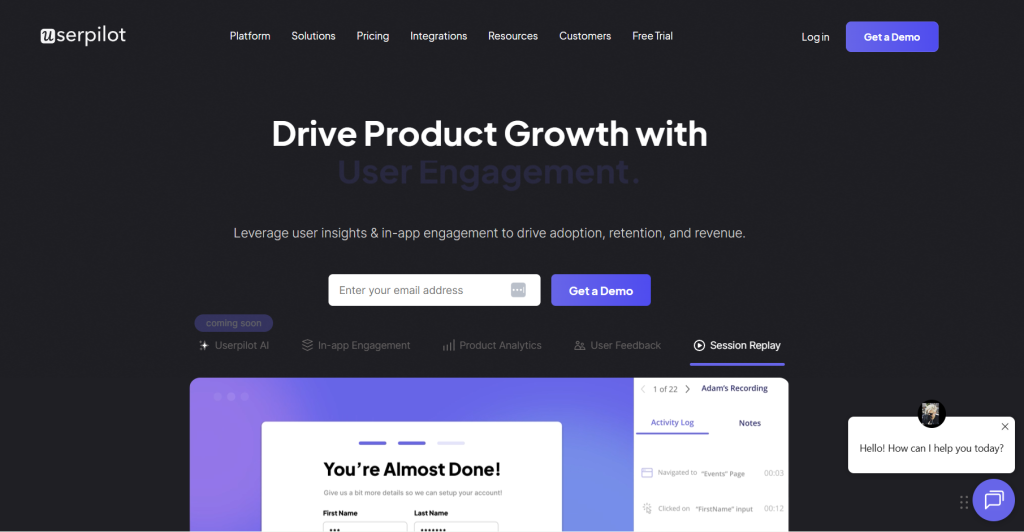
Userpilot is a product growth platform built for SaaS companies. Its core use case is helping product and customer success teams improve how users experience a product after they sign up, through in-app onboarding flows, feature adoption tools, product analytics, user feedback collection, and more recently session replay and lifecycle email.
The target buyer is typically a product manager, head of customer success, or growth-focused founder at a B2B SaaS company somewhere between early traction and mid-market scale. The problem Userpilot solves is the gap between a user signing up and a user actually getting value from the product. That gap is where most SaaS churn starts.
Its closest competitors are Pendo, Appcues, UserGuiding, Userflow, and Chameleon, with Mixpanel and Contentsquare overlapping on the analytics side.
The category sits at the intersection of product analytics, digital adoption, and in-app engagement, which is part of why the positioning question is genuinely hard. The market is real, growing, and contested by players with different wedges into the same buyer.
Understanding that context matters for the rest of this audit. The SEO gaps discussed below are not the result of a weak product or a small market. They are the result of a content strategy that outgrew its commercial foundation, in a category where several competitors have been more deliberate about owning the searches that matter most.
The Data Caveat Worth Handling Once
SEMrush:
Ahrefs:
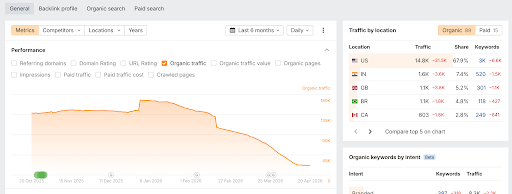
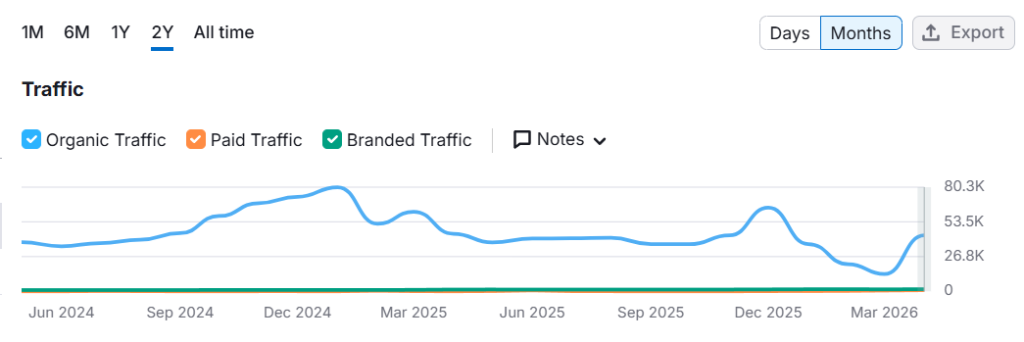
Ahrefs puts Userpilot’s organic traffic at around 21,700 monthly visits, down roughly 51,700 from its peak. SEMrush shows 43,100. The gap is large and unsurprising. Third-party tools use different keyword databases, click models, and update cadences. Neither number is authoritative.
What matters is whether both tools agree on the shape of the situation.
Here, they do.
Both point to the same picture: a meaningful organic footprint that has dropped materially from its peak, a site that is almost entirely non-branded in its traffic base, a keyword mix that skews heavily informational, and a page set where blog posts are doing most of the visible work rather than product or category pages.
That is enough signal to draw useful conclusions. A good audit does not need precision on the absolute number. It needs clarity on the strategic pattern underneath it.
What the Decline is Actually Telling You
The Ahrefs traffic chart over the past six months is not ambiguous. Traffic peaked around late January 2026 and has fallen steeply through April.
The more telling detail is in the ranking band breakdown. Positions 1 to 3, positions 4 to 10, and positions 11 to 20 have all compressed downward together over the same period. When a single band collapses, the cause is usually a handful of specific pages.
When all bands move together, the cause is usually broader: a wide content set losing relevance alignment, a quality signal affecting a whole topic cluster, or a ranking shift depressing a particular page type at scale.
The referring domain profile tells a different story entirely. It has grown steadily and continuously through the same period, now sitting above 8,200 domains. That distinction changes the diagnosis significantly.
When a site loses links and traffic simultaneously, domain authority is often part of the problem, and the response should lean off-page. When a site gains links while traffic falls, authority is unlikely to be the primary issue. The problem sits somewhere closer to content-to-intent fit. In Userpilot’s case, the evidence points toward the second scenario.
The SEMrush position change data makes this concrete. Among the keywords showing the largest traffic drops are “quantitative data,” “metrics analytics,” “customer analytics software,” “onboarding software,” and “churn rate analysis.”
Those are informational or loosely commercial terms, not bottom-of-funnel buying queries. Userpilot appears to have accumulated rankings across a wide set of adjacent educational topics, and those rankings have shifted. The authority is still there. The page-to-intent match has weakened.
That is a specific and solvable problem. It is also a different problem than most teams assume when they first look at declining traffic.
One Page, 83% of the Traffic
One page in the dataset reveals more than the rest.
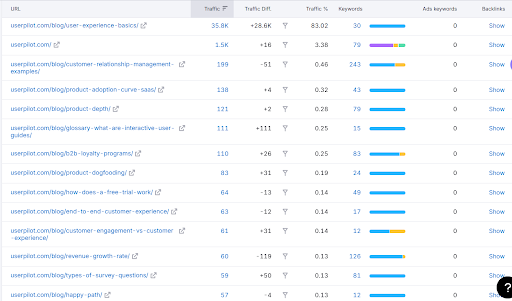
Userpilot’s blog post on user experience basics shows up in the SEMrush organic pages report driving approximately 35,800 monthly visits. That is roughly 83% of the site’s measurable traffic in that snapshot.
That is not automatically a problem. A single high-traffic educational post can be a legitimate demand asset. But it creates an immediate strategic question that the data cannot answer from the outside: what happens after the click?
Does that page route readers toward Userpilot’s product?
Does it build topical authority that supports commercial pages ranking higher?
Does it move visitors into onboarding, adoption, or analytics use cases?
Or does it absorb 35,000 visits per month that have no natural path toward product consideration?
The wider traffic distribution gives context. Ahrefs shows 40.4% of organic pages receiving zero traffic, 59.5% receiving between 1 and 1,000 visits per month, and only 0.1% reaching the 1,000 to 10,000 range.
There is one large spike, a thin tail of modestly performing pages, and a substantial portion of the site doing nothing measurable.
That is a fragile structure. The headline traffic number looks more stable than it is, because it is built on a single page rather than a deep commercial layer. If that page loses its rankings, or if it is already failing to convert, the entire organic channel is more exposed than the total visit count suggests.
There is also a crawl and equity problem hiding in that distribution. When 40% of a site’s pages receive zero organic traffic, those pages are consuming crawl budget and diluting the internal link equity that should be flowing toward pages that matter commercially.
That compounds the underperformance of the shortlist-stage page layer without ever appearing in a headline traffic report.
The Intent Gap Nobody Puts in the Dashboard
This is where the audit gets specific.
Ahrefs breaks Userpilot’s keyword profile into roughly 79% informational (22,900 keywords driving approximately 40,900 visits), 14.8% commercial (4,300 keywords driving approximately 886 visits), 4.1% navigational, and 2.1% transactional.
Read those commercial numbers again. 4,300 commercial-intent keywords generating fewer than 900 estimated visits per month. Informational keywords generating 40,900. The site has accumulated enormous reach in educational territory and very limited reach in the territory where buyers are actively evaluating options.
That gap is the core of this audit.
This pattern is not unique to Userpilot. It is one of the most common patterns in B2B SEO across categories.
Educational content scales well. It compounds. It earns links organically. It fills a content calendar and shows results in traffic dashboards.
Commercial content is harder to rank, has lower volume individually, and requires a different kind of investment. So over time, the educational layer grows faster than the commercial layer, and the site starts to look healthy in aggregate while being weaker than it should be in the searches that actually move pipeline.
The problem is not that informational content exists. Informational content at scale is a legitimate strategy for reaching buyers before they know what they need. The problem is when it becomes the center of gravity and the commercial pages never get the same level of care, structure, or investment.
At that point, the content operation is doing acquisition work but not enough conversion work. Traffic grows and revenue does not follow it at the same rate.
What the SERPs Actually Show
The live search results are where the audit becomes practical, because they show the gap between estimated rankings and actual competitive reality.
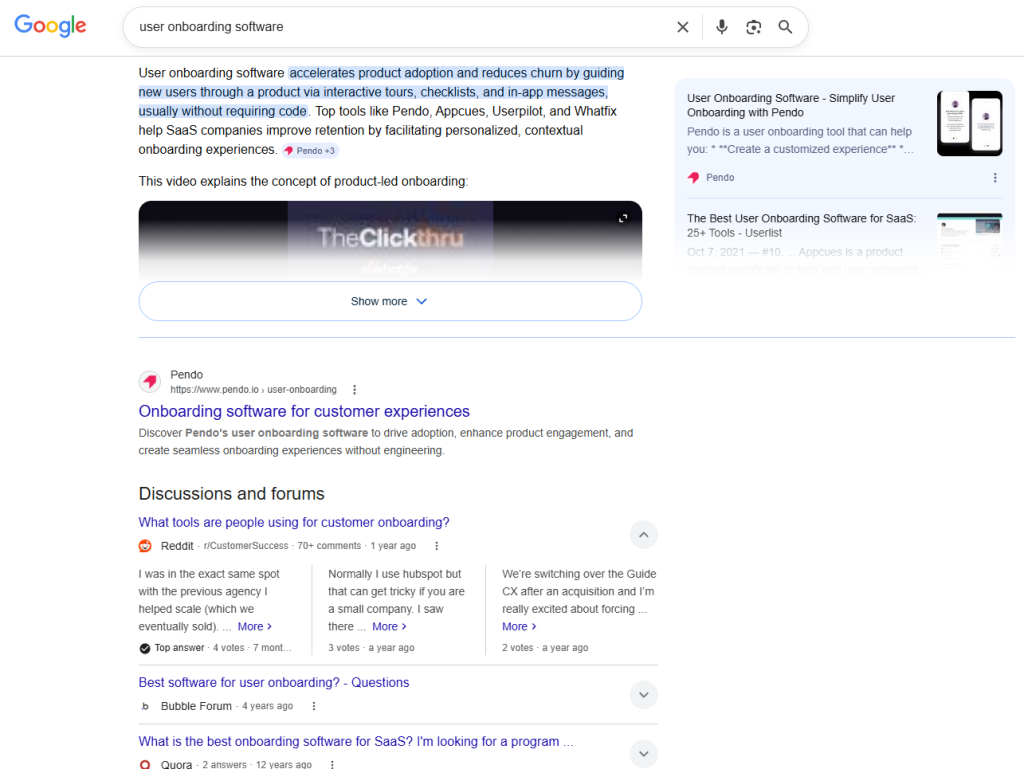
For “user onboarding software,” Google’s AI Overview names Appcues, Pendo, Userflow, and UserGuiding as the top tools. Userpilot does not appear in the AI Overview at all. Pendo holds the first organic position with a dedicated product page built specifically for that query. Userpilot is not visible in the first screen of results.
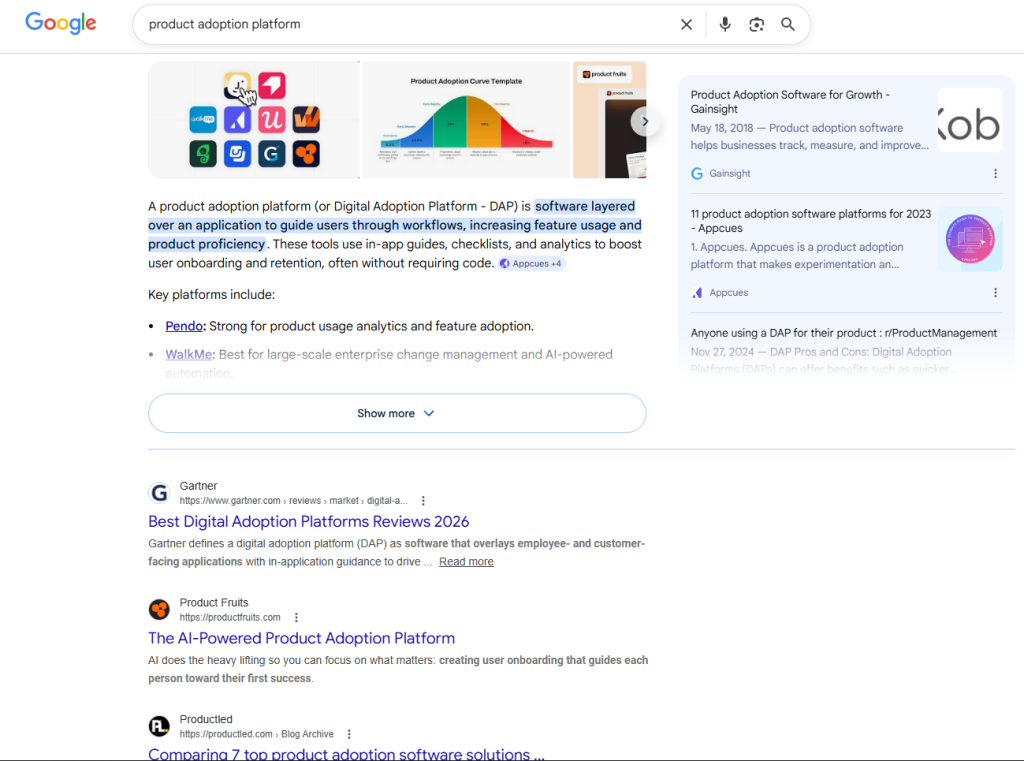
For “product adoption platform,” Userpilot appears in the AI Overview but as a parenthetical alongside Pendo, WalkMe, and Appcues. The first organic result is Gartner’s Digital Adoption Platform category page. Tango.ai’s comparison post ranks above Userpilot’s own result.
The Userpilot page that does rank is a blog post about digital adoption platforms, not a purpose-built product or category page. The intent is commercial. The page answering it is educational.
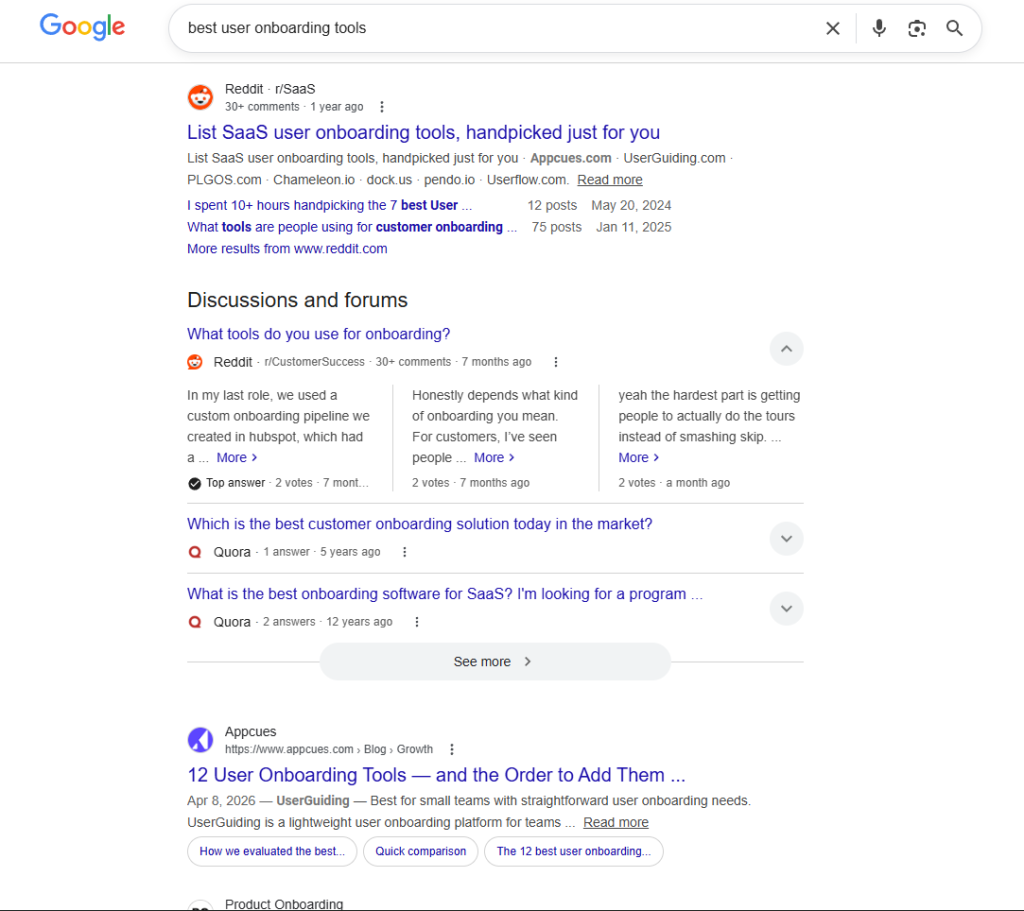
For “best user onboarding tools,” Userpilot gets named positively in the AI Overview alongside Appcues and Userflow. That is a genuine positive signal and worth acknowledging. Below the AI Overview, though, the organic results are controlled by Appcues’ blog and Reddit threads, not by Userpilot product or category pages.
For “Appcues alternatives,” Userpilot is cited as a top alternative in the AI Overview and appears in multiple third-party list articles. But Userpilot does not appear to own that query from its own domain. The pages ranking include flook.co, hopscotch.club, and Userflow’s dedicated comparison page.
Userpilot is being recommended by others. It is not controlling the page where the comparison happens.
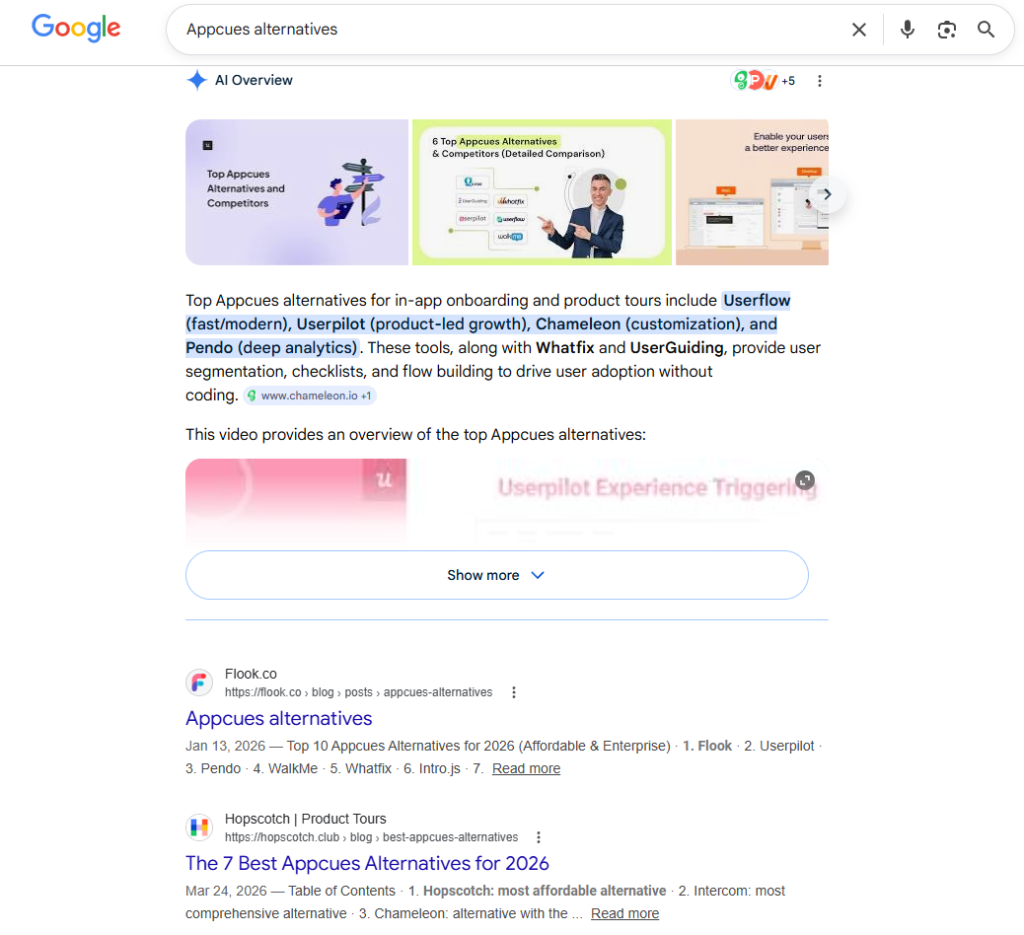
That last distinction matters more than it might look. Being mentioned in an AI Overview summary sourced from third-party pages is different from owning the page that ranks for that query. The first gives you brand presence. The second gives you the ability to control the narrative, the framing, the CTA, and the next step for a buyer who is actively shortlisting vendors.
The AI Overview Problem Nobody is Talking About Enough
Every SERP in this dataset includes an AI Overview. That is now the default for most commercial and informational queries, and it changes the math of organic visibility significantly.
AI Overviews synthesize answers from multiple sources. They tend to favor pages that directly and specifically match the query, not pages that broadly touch the topic. A blog post that mentions “user onboarding software” in the context of a larger educational article competes differently for AI Overview inclusion than a dedicated page whose entire structure is built to answer that exact query.
Looking across the four SERPs in the data, a specific pattern emerges for Userpilot. On “user onboarding software,” absent entirely. On “product adoption platform,” present but peripheral. On “best user onboarding tools,” named positively. On “Appcues alternatives,” cited via third-party sources rather than its own pages.
The pattern suggests that Userpilot has strong enough brand recognition to appear in AI synthesis when other sources write about it, but lacks the owned, purpose-built pages that would let it control what gets said and where the reader goes next. In the AI Overview results, the citation link matters. If Userpilot is appearing because Flook.co mentioned it in a listicle, the click goes to Flook.co, not to Userpilot.
As AI Overviews take a larger share of top-of-page real estate, the value of owning the source page grows. Being a supporting character in someone else’s content becomes less valuable.
The implication for any B2B company watching their traffic is direct: if you do not have pages specifically built to answer the commercial queries in your category, you will be mentioned but not visited, and eventually the mention frequency will fall too as AI learns to cite the most authoritative direct-answer pages.
What Userpilot is Doing Well
This is not a weak site, and saying that clearly matters.
Userpilot has built a more structured SEO system than most B2B companies at a similar stage. The site is not a blog attached to a homepage. It includes feature-level product pages, use-case pages organized around specific goals like user onboarding, expansion revenue, and churn prevention, role-based solution pages for product managers, customer success teams, product marketers, UX designers, and engineers, plus a resource layer with multiple content formats and the beginning of a comparison architecture.
That structure reflects an understanding that search intent is not uniform. A product manager evaluating onboarding tools does not need the same page as a CS lead trying to reduce churn.
A founder looking for “product adoption platform” is not in the same buying moment as a marketer searching “best NPS tools.” Building separate pages for separate intents is the right instinct, and most B2B companies do not do it at this level.
The role-based solution pages are particularly worth noting because they serve evaluation-stage buyers, the people who already know the category and are deciding whether the tool fits their specific team. Those pages are harder to build and easier to skip. Userpilot has not skipped them.
The referring domain profile reinforces the overall picture. Consistent growth to 8,200-plus domains through a period of traffic decline means the domain has earned genuine recognition. The issue is not whether Userpilot deserves to rank.
The issue is whether the right pages are built to capture the right searches.
Where the Opportunity is Larger than the Traffic Number
Three gaps stand out from the data as the highest-leverage areas.
Category Pages are Underbuilt Relative to the Content Library.
Userpilot ranks across a wide range of informational topics. It does not appear to hold the same force on the category-defining queries buyers use when they are actually evaluating solutions. “User onboarding software,” “product adoption platform,” “onboarding tools,” and “product tour software” are core buying-language searches with real volume.
In several of these, competitors appear with dedicated product or category pages while Userpilot surfaces through blog content.
The keyword gap data from SEMrush is specific about this. Missing terms include “collecting customer feedback,” “in-app,” “product tour,” “digital adoption platform software,” and “mobile app onboarding best practices.” These are not obscure queries.
They are terms with meaningful volume where Appcues and Pendo already hold top-10 positions, and Userpilot does not appear in the top results.
The fix is not more content. It is fewer, better-built buyer-intent pages designed specifically to win the searches buyers run when they are making shortlist decisions.
A well-built product page that directly answers “user onboarding software” will outperform a blog post on a related topic, regardless of the blog post’s overall traffic.
The Comparison Layer Needs to Be Expanded and Made More Deliberate.
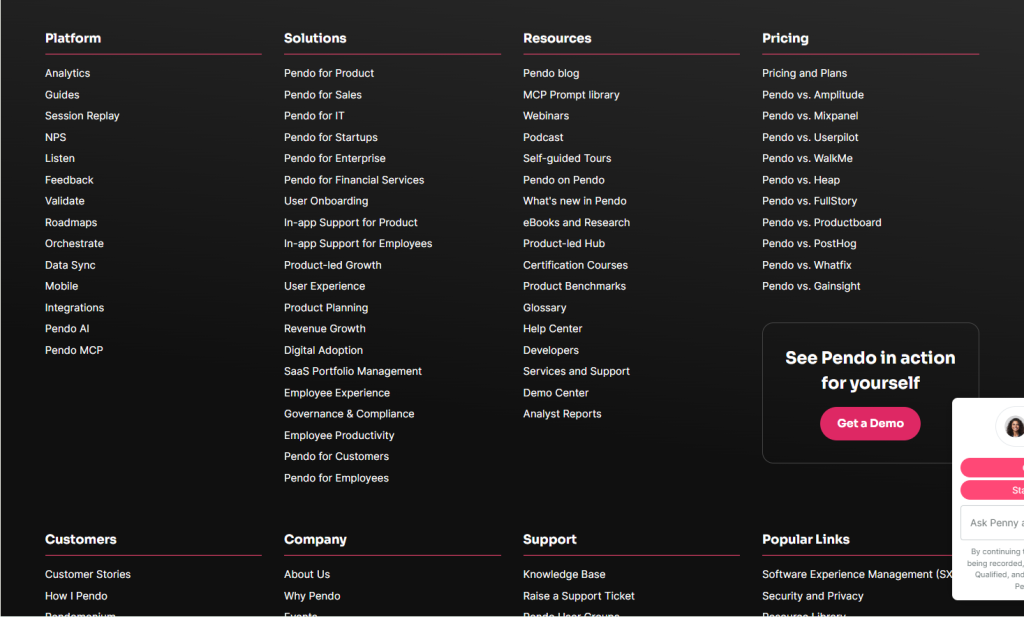
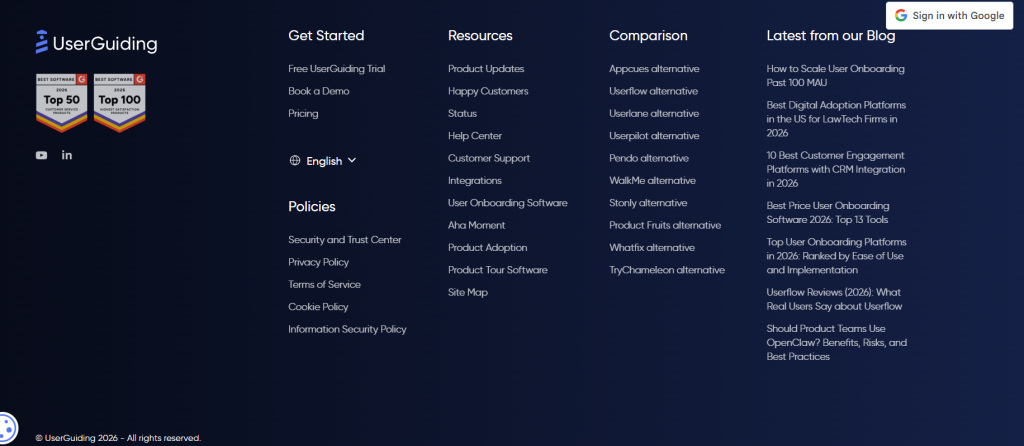
Pendo’s navigation and footer include dedicated comparison pages for Pendo vs. Amplitude, Pendo vs. Mixpanel, Pendo vs. Userpilot, Pendo vs. WalkMe, Pendo vs. Heap, Pendo vs. FullStory, and at least six more. UserGuiding’s footer includes alternative pages for Appcues, Userlane, Userflow, Pendo, WalkMe, Stonly, and others.
These are not side projects or one-off blog posts. They are structured assets sitting in the permanent navigation architecture.
Pendo’s footer
UserGuiding
Userpilot appears to have some comparison pages, but not the same depth or deliberateness. For a query like “Appcues alternatives,” where Userpilot is named as the top alternative in Google’s AI Overview, not having a purpose-built page ranking for that query is a specific gap with a specific fix.
A buyer searching that term is close to a decision. If they click through to a third-party list on flook.co, Userpilot cannot control what that page says, which competitors it favors, or where the reader goes next.
Comparison content at this stage of B2B buying is not marketing collateral. It is distribution infrastructure.
Educational Traffic Needs Stronger Pathways into Commercial Pages.
The content layer is clearly doing acquisition work. The open question is whether it is doing transition work. A visitor who finds Userpilot through a post on user experience basics or churn rate analysis has arrived with a specific problem in mind. The site has one moment to connect that problem to Userpilot’s product story.
That connection requires more than a generic “Get a Demo” button at the bottom of a blog post. It requires contextually relevant internal links to the right product page, a case study from a company in a recognizable situation, a comparison page that matches the visitor’s likely evaluation frame, or a use-case page that speaks directly to the problem they searched for.
When that routing is absent or generic, the educational traffic becomes a library rather than a funnel. Visits accumulate. Pipeline does not follow.
The Platform Narrative and Its Search Tradeoff
Userpilot’s homepage messaging spans product analytics, user engagement, user feedback, session replay, mobile, email, workflows, onboarding, churn prevention, and product adoption. That breadth makes commercial sense. A wider platform story supports larger deals, more buyer types, and a broader market.
But broad platform positioning creates a specific problem in search that does not fix itself automatically.
The pages that dominate category queries tend to be narrow. The page winning “user onboarding software” is usually a page whose entire structure answers that exact question, not a page that explains the whole platform and mentions onboarding along the way.
Pendo wins “onboarding software for customer experiences” with a page built specifically around that query. Appcues wins “best user onboarding tools” comparisons with a content approach that stays close to that topic. UserGuiding ranks for “user onboarding software” on a page that never explains its full product scope.
Userpilot does not need to simplify its product to win these searches. It needs pages that answer specific commercial queries directly, regardless of how broad the overall positioning is.
A platform can tell a broad story on the homepage and still build narrow, focused pages for each category it competes in. The two things are not in conflict. But the narrow pages have to actually be built and optimized for those specific searches, not just exist as subsections within a larger product description.
This is one of the clearest lessons in this dataset. Product breadth can help the business while quietly weakening category capture in search, if the page strategy does not compensate for it.
If I Were a Competitor of Userpilot, This is What I Would Do
This section exists to make something concrete. There are always exploitable gaps in any site’s SEO position, no matter how well-built. The gaps in Userpilot’s current footprint are readable from public data, and any competitor paying attention could act on them systematically.
One contrast is worth naming before the specific moves. Appcues held relatively flat organic traffic across the same six-month period where Userpilot’s declined.
That rules out the simplest explanation. If this were category-wide demand softening, Appcues would be falling alongside Userpilot. It is not. That makes the pattern look less like an external market shift and more like an execution difference at the page and intent layer.
Which means the gaps below are real opportunities, not just timing plays.
Build a “Userpilot alternatives” Page and Invest in it Properly.
Userpilot has a page at this URL and it drives 113 visits per month according to Ahrefs, with “userpilot alternatives” as the top keyword.
That is a low number for a page that sits at high buying intent. A competitor with better page structure, stronger comparison depth, and more deliberate internal routing could rank above it for that query. The visitor arriving on a “Userpilot alternatives” page is not browsing.
They are evaluating. Owning that page owns the conversation at the most commercially sensitive moment.
Target the Keywords Userpilot is Visibly Losing.
The SEMrush position change data shows specific keywords where Userpilot’s traffic has dropped materially: “onboarding software” (down 168 visits), “customer analytics software” (down 191), “digital adoption software” (down 94), “product led onboarding” (down 96).
These are not obscure terms. They are categories where Userpilot had accumulated positions and has since lost ground. A competitor who builds dedicated pages for these specific queries, rather than blog posts that reference them loosely, could claim that traffic at a moment when the incumbent’s presence has weakened.
Own the AI Overview Citations by Building the Source Pages.
For “user onboarding software,” the AI Overview currently cites Appcues, Pendo, Userflow, and UserGuiding. Userpilot is absent. The pages earning those citations are product pages and category pages with direct, specific answers to that query.
A competitor who does not yet appear in that AI Overview has a clear structural path to getting in: build a page that answers the question better and more directly than the pages currently cited. AI Overviews are not static. They update as better source pages emerge.
Exploit the Educational Traffic Concentration.
83% of Userpilot’s measurable traffic running through one educational post is a vulnerability as much as it is an asset.
A competitor who publishes a better-built, more current, more deeply linked version of that content type, user experience frameworks, product onboarding primers, adoption strategy guides, could divert significant traffic from a page that is currently doing most of the heavy lifting for the entire domain.
Educational dominance at scale is not permanent. It requires continued investment to hold.
Match and Extend the Comparison Layer.
Pendo has built a comparison page for “Pendo vs. Userpilot.”
Userpilot should have a mirror of that page and a deeper set of competitor-specific comparison pages. A competitor who builds those pages first, especially for queries where Userpilot is already being mentioned as an alternative, takes over the narrative before Userpilot does.
In a market where buyers already know the major players by name, comparison pages are often where the final vendor decision gets made. Whoever builds those pages first, and builds them well, tends to win them.
Intercept the Evaluation-Stage Searches Userpilot is Missing.
The keyword gap analysis shows high-value terms where Userpilot has no top-10 presence: “product tour software,” “digital adoption platform software,” “user onboarding software,” “in-app,” “onboarding tools.” These are the searches buyers run when they are close to a decision.
A competitor with dedicated pages for each of these queries, pages that directly answer the commercial intent rather than educating around it, is positioned to capture demand at the moment it is most ready to convert.
The broader point is not specific to Userpilot. Every site with a content-heavy, informational-skewed SEO program has versions of these gaps. The companies that spot them first, in their own site or in a competitor’s, are the ones that win the commercial search layer without necessarily having more total traffic.
What Internal Data Would Change
This audit is built entirely on public signals. Several questions cannot be answered without internal access.
Whether the high-traffic educational pages assist conversions at meaningful rates.
Whether the commercial page layer, where it exists, converts at a rate that justifies deeper investment even at lower traffic volumes.
Whether the traffic decline has affected pipeline or whether that traffic was always low-quality.
Whether the referring domain growth translates into authority for commercial pages specifically, or whether it is concentrated on the educational content.
Which queries generate impressions without clicks, which would identify the gap between SERP visibility and actual traffic capture.
None of those questions changes the strategic direction. They change the sequencing and the prioritization within it. The external picture is already clear enough to act on.
What B2B Teams Should Take From This
Audit Intent Mix Before Traffic Totals.
A site with 40,000 monthly visits where 79% of keywords are informational can be further from revenue than a site with 10,000 visits and a better commercial intent balance. The number that matters is not visits. It is the share of visibility that sits in searches where buyers are actually evaluating.
Build Evaluation-Stage Pages Before Scaling Content Output.
Most B2B content programs build educational content first because it is faster and easier. The harder work, category pages, comparison assets, use-case pages, and shortlist-stage landing pages, gets deferred. That is the wrong order. Pages built for in-market searches should be validated before the educational library gets expanded again.
Own the Comparison Layer, Not just the Category.
If buyers are searching for alternatives to your competitors and third-party pages are capturing that demand, that is a distribution gap with a direct fix. The pages that rank for comparison searches are not difficult to build. They are just consistently deprioritized.
Treat Traffic Concentration as a Structural Risk.
One breakout educational post driving the majority of organic traffic is not a success story. It is a single point of failure. Commercial resilience in SEO comes from a deep layer of pages that each do a specific job, not from one page doing everything.
Separate Authority from Page Strategy.
If referring domains are growing while traffic falls, the problem is not links. The problem is what the site is asking that authority to rank. More links will not fix a content-to-intent mismatch. Better pages will.
Design Pathways, not Just Pages.
Every educational page that earns a click has one job beyond the click itself: move the visitor toward the next relevant commercial step. A contextually matched internal link, a use-case CTA, a comparison page entry point. Generic “Get a Demo” buttons at the bottom of educational posts are not pathways. They are suggestions that most readers ignore.
The Real Lesson
This is not a failing SEO program. It is a pattern that many well-run B2B companies eventually reach.
The content layer was built thoughtfully. Authority was earned honestly. Visibility grew over time. And then the program reached the point where adding more of the same thing stopped producing proportional returns.
That is the inflection point where strategy has to change.
From coverage to concentration. From publishing cadence to page quality. From traffic growth to intent ownership. From building visibility to building a system that turns that visibility into commercial momentum.
The useful question is whether your own site shows the same pattern: strong educational reach, weak ownership of evaluation-stage queries, and too much dependence on content that informs without moving buyers closer to a decision.
That pattern looks fine in a traffic dashboard. It does not look fine in a revenue conversation.
And the companies that figure out the difference, before a traffic decline forces the question, are the ones that get ahead of it rather than respond to it.