

Table of Contents
- The Real Reason Most SEO Strategies Fail
- The Blog-First Trap
- SEO is a Coverage Problem, Not a Content Problem
- What Actually Works: A Structure-First Approach
- Programmatic SEO and Scaling Coverage
- The Reality of Content Velocity and Market Gaps
- How Content Needs Differ by Business Type
- How to Know if You Are Under-Publishing Compared to Your Market
- What You Should Do Next
- Estimating How Much Content You Actually Need
- The Takeaway is Simple.
Most businesses are not failing at SEO because they are not producing content.
They are failing because they are producing the wrong content, in the wrong order, with no system behind it.
You see this pattern constantly. A company commits to SEO, hires a writer or an agency, and starts publishing blog posts every week. Three months later, nothing meaningful has changed. Six months later, traffic might be slightly up, but revenue is flat. After a year, leadership starts questioning whether SEO is worth it at all.
The problem is not effort. The problem is the model.
Most SEO strategies are built on the assumption that publishing content leads to rankings, and rankings lead to traffic, and traffic leads to revenue. That sequence sounds logical, but it breaks down in practice because it ignores how search demand is actually structured.
SEO is not a content production problem. It is a coverage problem.
Until that is understood, more content will not fix anything.
The Real Reason Most SEO Strategies Fail
If you look at underperforming SEO campaigns, the issue usually appears before the first article is even written.
The strategy starts with keywords, then moves directly into content production. There is little or no consideration of whether the site has the right pages to capture demand, whether the structure supports internal linking, or whether the business is even targeting the right layer of intent.
This leads to a pattern where teams publish isolated pieces of content that are not connected to a broader system.
For example, a B2B company might publish articles about general industry topics, but have no dedicated pages for the industries they actually serve. A SaaS company might write educational content about their category, but lack feature pages, use-case pages, or comparison pages that match how buyers evaluate tools. A local business might publish blog posts while missing location pages for the areas they want to rank in.
In all of these cases, content is being produced, but it is not aligned with how people search or how decisions are made.
The result is predictable. Rankings are inconsistent, traffic is low quality, and conversion rates remain weak.
The strategy fails because it is built on output instead of structure.
The Blog-First Trap
One of the most common patterns in lean teams is what can be described as the “blog-first” approach.
The logic is simple. Blogging feels accessible. It does not require deep structural changes to the site, it can be outsourced easily, and it creates visible activity. Publishing four to eight articles per month gives the impression that SEO is moving forward.
The issue is that blogging is often the least effective starting point.
If the core pages that capture commercial intent are missing, blog content has nowhere to convert. Even if some articles start ranking, they tend to target informational queries. These queries may drive traffic, but they do not necessarily drive revenue.
Consider a SaaS company in the project management space. If they publish articles like “how to improve team productivity” or “what is agile workflow,” they may attract visitors.
But if they do not have pages like “project management software for agencies,” “project management software for construction,” or “Asana alternatives,” they are missing the queries where buyers are actively evaluating solutions.
The same applies to B2B services. Writing articles about general industry trends does not replace having pages that map services to industries or problems. For local businesses, publishing blog content does not replace having service pages for each offering and location pages for each target area.
Blogging becomes a layer of expansion, not the foundation.
Starting with it often leads to months of effort with very little return.
SEO is a Coverage Problem, Not a Content Problem
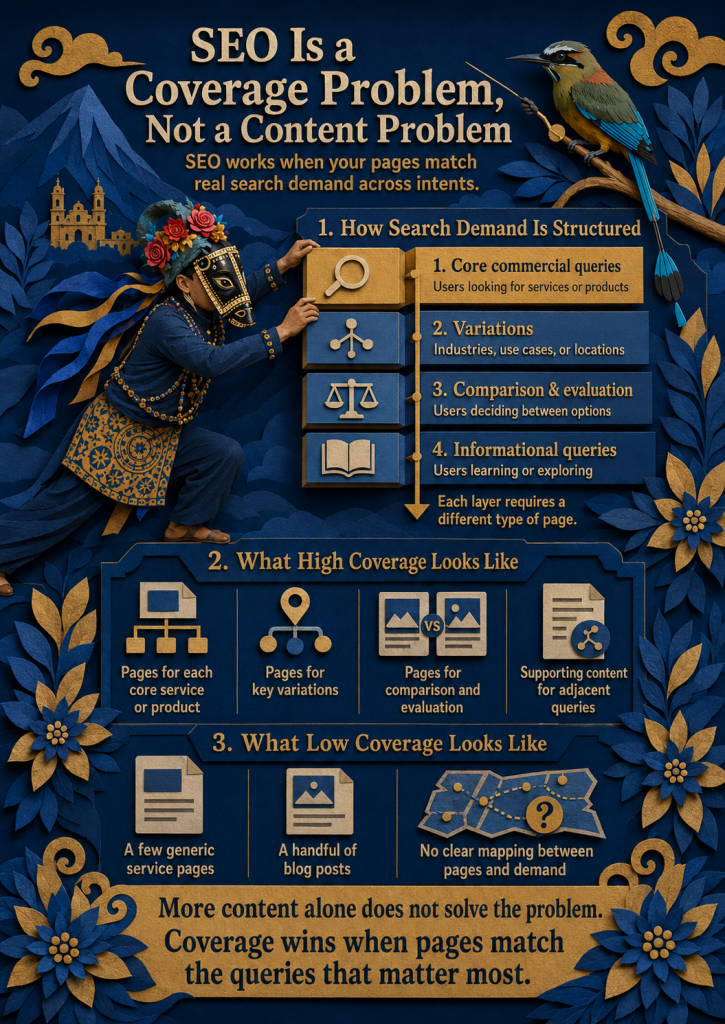
To understand what works, you need to shift how you think about SEO.
Search demand is not a flat list of keywords. It is a structured set of queries that map to different intents and different stages of decision making.
At a high level, this demand can be broken into layers:
- Core commercial queries, where users are looking for services or products
- Variations of those queries, often tied to industries, use cases, or locations
- Comparison and evaluation queries, where users are deciding between options
- Informational queries, where users are learning or exploring
Each of these layers requires a different type of page.
If your site does not have pages that match these queries, you are not competing, regardless of how much content you publish.
This is what “coverage” means in practice. It is the extent to which your site has pages that match the demand that exists in your market.
A site with high coverage has:
- pages for each core service or product
- pages for key variations of those services or products
- pages that support evaluation and comparison
- supporting content that expands into adjacent queries
A site with low coverage might have:
- a few generic service pages
- a handful of blog posts
- no clear mapping between pages and demand
In that situation, increasing content output does not solve the problem. It simply adds more pages that are disconnected from the queries that matter most.
What Actually Works: A Structure-First Approach
If you look at sites that consistently grow through SEO, they tend to follow a similar pattern.
They do not start with blogging. They start with structure.
1. Foundation: Building the Right Pages
The first step is to build the core pages that capture primary demand.
These pages vary by business type, but they typically include:
- Service or product pages that clearly define what you offer
- Sub-service or feature pages that break those offerings into specific components
- Industry or use-case pages that map your offering to different audiences
- Location pages for businesses that operate in multiple areas
- Category or collection pages for ecommerce businesses
For example, a SaaS company might have:
- a core product page
- feature pages for each major capability
- use-case pages for different teams or industries
- integration pages for key tools
A B2B company might have:
- core service pages
- industry-specific pages
- solution pages that address specific problems
An ecommerce business might have:
- category pages
- subcategory pages
- filtered or faceted pages that match how users search
A local business might have:
- core service pages
- individual service pages
- location pages for each target city or area
This foundation is not a one-time task. It is front-loaded, meaning a significant portion of it is built in the first few months, but it continues to expand over time as new opportunities are identified.
Without this layer, everything else is limited.
2. BOFU Pages: Capturing Evaluation Intent Early
The second layer is bottom-of-funnel content, often referred to as BOFU.
These are the pages that target users who are actively evaluating options.
They include:
- “[product] vs [competitor]” pages
- alternative pages
- comparison guides
- “best [category] for [use case]” pages
These pages are critical because they often sit closest to conversion.
A user searching for “HubSpot alternatives” or “best CRM for small business” is much closer to making a decision than someone searching for “what is CRM.”
Despite this, many teams delay building these pages, assuming they should come later.
In practice, these pages should be built early, often alongside the core structure.
For SaaS and B2B companies in particular, these pages can drive some of the fastest initial returns from SEO. For ecommerce, comparison and “best of” pages can capture high-intent traffic that category pages alone may not fully address.
Treating BOFU as a secondary phase slows down results unnecessarily.
3. Content Velocity: Expanding Coverage Over Time
Once the foundation and BOFU layers are in place, content velocity becomes meaningful.
This is where ongoing publishing comes into play.
At this stage, content serves multiple purposes:
- expanding into long-tail queries
- reinforcing topical authority
- supporting internal linking between pages
- capturing additional variations of demand
This is where blog content becomes valuable.
However, it is effective because it sits on top of a structure that already captures core demand and supports conversion.
Without that structure, increasing publishing volume often leads to diminishing returns.
Programmatic SEO and Scaling Coverage
As markets become more competitive, manual content production alone is often not enough to achieve full coverage.
This is where programmatic SEO becomes relevant.
Programmatic SEO is not about generating low-quality pages at scale. It is about using structured templates and data to systematically create pages that match known patterns of demand.
For example:
- A SaaS company might create pages for each feature across multiple industries or use cases
- A B2B company might generate service pages for different sub-industries
- An ecommerce business might expand category and subcategory pages based on search demand
The goal is to cover combinations that exist in the market in a scalable way.
For lean teams, this does not require complex infrastructure from day one. It starts with identifying repeatable patterns and building pages that follow those patterns consistently.
Over time, this approach allows you to expand coverage far beyond what manual blogging alone could achieve.
The Reality of Content Velocity and Market Gaps
One of the most overlooked aspects of SEO is relative output.
Teams often look at their own publishing cadence in isolation. They might publish four or eight pages per month and feel that they are making steady progress.
What matters, however, is how that output compares to competitors.
In many markets, it is common to see companies publishing at significantly higher rates. Ten pages per month is not unusual. In more aggressive environments, teams may publish twenty or thirty pages per month, especially when combining manual and programmatic approaches.
If your output is consistently lower, you are not just growing more slowly. You are falling behind.
This creates a gap.
Competitors accumulate more pages, more internal links, and more opportunities to rank. Over time, this compounds. Even if you increase your output later, you are starting from behind.
Closing that gap takes time.
Publishing more content today does not erase the fact that competitors may already have hundreds of relevant pages.
This is why the order of execution matters so much.
If you start by building the right foundational pages, every additional page contributes more effectively. If you start with scattered blog content, you may end up with a large number of pages that do not meaningfully improve your position.
Content velocity matters, but only when it is applied to the right structure.
How Content Needs Differ by Business Type
Different business models require different types of pages and different levels of coverage.
Local Businesses
For local businesses, SEO is driven by service coverage and geographic relevance.
A company offering services like HVAC, plumbing, or landscaping needs:
- core service pages
- individual service pages
- location pages for each area they serve
Blogging can support growth, but it is not the primary driver of rankings.
If location and service coverage are incomplete, publishing more articles will not compensate for that.
SaaS Companies
SaaS SEO is driven by product understanding and use-case coverage.
A SaaS product in areas like analytics, customer support, or marketing automation typically needs:
- feature pages
- use-case pages
- industry pages
- integration pages
- comparison and alternative pages
These pages map directly to how buyers evaluate tools.
Blog content becomes important for expansion, but it should not replace the core product and evaluation pages.
B2B Services
B2B SEO relies heavily on mapping services to industries and problems.
A company offering services like consulting, logistics, or IT solutions often needs:
- service pages
- industry-specific pages
- solution pages
- comparison and evaluation content
The goal is to connect what you offer to the specific contexts in which it is used.
Publishing general content without this mapping limits both visibility and conversion.
Ecommerce Businesses
Ecommerce SEO is driven by category and product coverage.
Stores in niches like apparel, electronics, or home goods typically need:
- category pages
- subcategory pages
- expanded collection pages based on search demand
In addition, comparison and “best of” pages can capture high-intent traffic.
Blog content supports growth, but the primary driver of traffic is the structure of categories and collections.
How to Know if You Are Under-Publishing Compared to Your Market
Most teams evaluate their performance based on what they are doing, not what is required.
A more useful approach is to look at relative output and coverage.
If competitors are consistently expanding into new pages, covering more variations, and building more connections between those pages, they are increasing their share of search demand.
Signs that you may be under-publishing or under-covering include:
- competitors ranking for queries you do not have pages for
- gaps in industry, use-case, or location coverage
- limited presence in comparison or evaluation queries
- a site structure that has not expanded in months
The goal is not to match competitors page for page immediately.
The goal is to build a structure that allows you to compete, and then increase output in a way that steadily closes the gap.
What You Should Do Next
For founders and lean teams, the challenge is not just knowing what to do, but deciding where to start.
A practical approach looks like this:
- Identify missing page types, not just missing topics
- Build or expand your core structure
- Add BOFU pages that capture evaluation intent
- Increase content velocity once the foundation is in place
- Expand coverage through structured and, where appropriate, programmatic approaches
This sequence aligns effort with impact.
It ensures that each new page contributes to both rankings and revenue.
Estimating How Much Content You Actually Need
The exact number of pages required depends on your market, your business model, and how competitive your space is.
There is no single number that applies to every business.
What matters is understanding:
- how much demand exists
- how much of that demand is already covered by competitors
- how many pages are required to capture that demand
That is what this site’s tools are designed to help you estimate.
You can use the SEO production planner to understand how many pages you likely need, the cost calculator to see what level of investment supports that output, and the ROI calculator to estimate the potential return.
Taken together, they provide a clearer picture of what it actually takes to compete in organic search.
The Takeaway is Simple.
SEO does not fail because content does not work. It fails because most strategies focus on content production without building the structure required to make that content effective.
When you shift from publishing pages to building coverage, the entire approach changes.
And that is where SEO starts to work as a growth channel, not just a marketing activity.