
Table of Contents
- What Is SEO and How Does It Help a Business?
- SEO Captures Existing Customer Demand
- SEO Can Generate More Qualified Leads
- SEO Expands Non-Branded Visibility
- SEO Reaches Buyers at Different Stages of the Decision
- SEO Builds Brand Visibility and Familiarity
- SEO Strengthens the Pages Closest to Revenue
- SEO Improves Website Structure and Usability
- SEO Creates Marketing Assets That Can Keep Producing
- SEO Reduces Dependence on Paid Acquisition
- SEO Helps Small Businesses Compete Locally
- SEO Supports Long B2B Buying Journeys
- SEO Provides Better Customer and Market Data
- SEO Helps Businesses Identify Competitor Gaps
- SEO Creates Leverage for Lean Marketing Teams
- SEO Supports Visibility Across Modern Google Search
- How SEO Benefits Different Types of Businesses
- What Are the Benefits of Using an SEO Agency?
- When Does SEO Make Sense for a Business?
- Common misconceptions about the benefits of SEO
- Frequently Asked Questions About the Benefits of SEO
- The Business Value of SEO
SEO helps businesses get discovered when potential customers search for the products, services, problems, and comparisons connected to what they sell.
The business benefits go well beyond rankings.
A strong SEO strategy can attract qualified traffic, generate leads, strengthen important website pages, expand brand visibility, reduce dependence on paid acquisition, and create organic assets that continue producing after the initial work is complete.
The value also changes by business model. A local contractor may care about calls and booked jobs. A B2B company may need qualified pipeline. A SaaS company may need product discovery and comparison visibility.
The common thread is simple: SEO connects existing search demand with the pages capable of turning that demand into business.
What Is SEO and How Does It Help a Business?
Search engine optimization, or SEO, is the process of improving your website so search engines can understand its pages and potential customers can find them when searching.
That includes much more than adding keywords to articles.
SEO can involve:
- keyword and search-intent research
- service, product, category, and landing page optimization
- technical SEO
- site architecture
- internal linking
- content
- backlinks and authority building
- local search optimization
- measurement and conversion analysis
The goal is to create stronger connections between what people search for and what your business offers.
| SEO benefit | Business impact |
|---|---|
| Qualified organic traffic | Brings people already searching for relevant products, services, or solutions. |
| Non-branded visibility | Helps new prospects discover your business before they know your brand. |
| Lead generation | Connects commercial searches with pages designed to produce calls, demos, bookings, or sales. |
| Stronger website | Improves structure, page clarity, navigation, internal links, and commercial content. |
| Long-term acquisition value | Creates pages and site improvements that can continue producing traffic after publication. |
| Customer insight | Reveals what customers search for, compare, question, and need before buying. |
SEO Captures Existing Customer Demand
One of the biggest benefits of SEO for business is its ability to reach people who are already searching.
Someone searching for a roofing contractor, payroll software, cybersecurity consulting, CRM pricing, or an ecommerce product category has already expressed some level of demand.
Your job is to appear for the searches that matter to your business.
This gives SEO a different role from marketing channels built primarily around audience interruption. Search lets you respond to an action the potential customer has already taken.
The closer the keyword, page, and offer match that person’s intent, the more commercially useful the traffic can become.
SEO Can Generate More Qualified Leads
Traffic has limited value when the visitors have little connection to what you sell.
Strong SEO focuses on search intent.
A commercial service page can target people looking to hire. A comparison page can reach buyers evaluating vendors. A pricing page can answer questions from prospects approaching a decision.
That creates a path from search query to relevant page to conversion.
For a local business, that conversion might be a phone call or estimate request.
For a B2B company, it might be a demo, consultation, or qualified lead.
For ecommerce, it might be a category visit, product view, or purchase.
The quality of the keyword-to-page match matters as much as raw search volume.
SEO Expands Non-Branded Visibility
Businesses with strong referral networks or established brands often perform well when someone searches for them by name.
Growth becomes harder when new customers do not know the company exists.
SEO helps close that gap.
Non-branded searches such as “commercial cleaning company,” “best project management software,” or “roof replacement contractor near me” allow businesses to reach prospects based on what they need rather than what company they already know.
That expands the size of the audience available to the business.
It also gives smaller companies opportunities to compete for demand that might otherwise flow toward established brands.
SEO Reaches Buyers at Different Stages of the Decision
Customers rarely perform 1 search and immediately buy.
They research problems, explore solutions, compare options, check pricing, investigate providers, read reviews, and return later.
SEO can create search entry points throughout that process.
A company might have pages targeting:
- problems and questions
- services or products
- use cases
- industries
- comparisons
- alternatives
- pricing
- locations
- implementation questions
Each page serves a different search intent.
Together, those pages increase the number of opportunities your business has to appear during the customer’s research process.
SEO Builds Brand Visibility and Familiarity
A potential customer may see your company several times before contacting you.
They might find an article during early research, encounter a service page later, see your business during a comparison search, and eventually search for your brand directly.
Organic visibility creates those repeated exposures.
This can be especially important for companies selling expensive services, complex software, consulting, or products with longer consideration periods.
SEO gives the business multiple chances to become familiar before a sales conversation begins.
That familiarity can make future interactions easier because the prospect already has some context about the company and its expertise.
SEO Strengthens the Pages Closest to Revenue
SEO is sometimes treated as a synonym for blogging.
A large part of the opportunity often sits elsewhere.
Service pages, product pages, category pages, location pages, solution pages, industry pages, and comparison pages frequently sit much closer to revenue.
Improving those pages can involve:
- clearer search targeting
- stronger topical coverage
- better headings
- improved internal links
- more useful supporting information
- better alignment between the search and the offer
This is where SEO becomes especially valuable as a business discipline.
The goal is to strengthen the parts of the website responsible for turning demand into action.
SEO Improves Website Structure and Usability
Search optimization frequently exposes website problems that also affect users.
Important pages may be buried too deeply.
Several pages may compete for the same topic.
Navigation may make important services difficult to find.
Internal links may send little authority toward high-priority pages.
Content may answer search queries without giving visitors a useful next step.
Correcting these issues creates a site that is easier for search engines to understand and easier for customers to use.
A better website structure also makes future SEO work easier because new pages have clearer relationships with the rest of the site.
SEO Creates Marketing Assets That Can Keep Producing
A well-built SEO page can continue generating impressions, clicks, leads, and sales after its initial publication.
That makes individual pages closer to long-term acquisition assets.
A service page can capture commercial searches for months or years.
A useful comparison can remain part of a buyer’s research process.
A strong category page can continue introducing new shoppers to products.
These assets still need maintenance. Competitors improve their sites, search behavior changes, and information becomes outdated.
The important business advantage is that every new month does not require recreating the entire channel from zero.
SEO Reduces Dependence on Paid Acquisition
Paid advertising can be an effective growth channel.
Dependence on it creates risk.
The business must continue buying exposure, and changes in cost per click, competition, targeting, or budgets can quickly affect lead volume.
Organic search adds another source of customer acquisition.
A company with meaningful SEO visibility can receive traffic from paid campaigns, referrals, direct visits, outbound activity, organic search, and other sources at the same time.
That creates a more balanced acquisition mix.
SEO can also help businesses reserve paid media for the searches, audiences, or campaigns where advertising provides the strongest incremental value.
SEO Helps Small Businesses Compete Locally
For many small businesses, search visibility has a geographic component.
Customers search for plumbers, dentists, roofers, electricians, restaurants, clinics, contractors, and other services near them.
Local SEO helps businesses improve their presence across local search results, Google Business Profiles, service-area searches, and location-specific pages.
The commercial value is straightforward.
A small business does not need visibility everywhere. It needs strong visibility among people who can realistically become customers.
This is why local SEO can be especially valuable for companies whose revenue depends on calls, appointments, estimates, showroom visits, or booked jobs within a defined service area.
SEO Supports Long B2B Buying Journeys
B2B SEO often has a different job.
Someone searching for an accounting firm, IT provider, staffing company, engineering consultant, or enterprise software platform may spend weeks or months evaluating the decision.
During that period, several people may research the vendor.
SEO can support the process through service pages, industry pages, implementation content, comparison pages, use cases, case studies, and educational resources.
That allows a B2B company to build visibility around both the solution and the questions that appear before purchase.
Organic traffic is only 1 measurement here.
Qualified opportunities, assisted conversions, sales conversations, pipeline, and revenue provide a better view of the business impact.
SEO Provides Better Customer and Market Data
Search behavior contains useful business information.
Keywords reveal how customers describe their problems.
Search Console shows which queries already connect users with your site.
Competitor rankings reveal categories and topics where other companies are earning visibility.
Conversion data can show which pages and search intents produce meaningful business outcomes.
This turns SEO into a research tool as well as an acquisition channel.
The information can influence website copy, product positioning, sales messaging, content priorities, service offerings, and paid search campaigns.
A strong SEO program should become better at prioritization as more data becomes available.
SEO Helps Businesses Identify Competitor Gaps
Search results provide a direct view of who is competing for customer attention.
Those competitors may differ from the companies your sales team considers traditional competitors.
A smaller brand, marketplace, directory, publisher, or niche specialist may own important searches even if it has little market share elsewhere.
SEO analysis can reveal:
- commercial searches competitors already own
- weak competitor pages
- missing topics
- underserved locations
- new category terminology
- content competitors have abandoned
- queries where your existing authority gives you a realistic opening
This helps businesses allocate resources based on observable search opportunities instead of broad assumptions.
SEO Creates Leverage for Lean Marketing Teams
Smaller marketing teams have to choose carefully where they spend time.
They cannot publish everywhere, run every campaign, and maintain every channel at the same level.
SEO can work well in that environment because the team can prioritize a smaller number of durable improvements.
That might mean fixing 5 high-value commercial pages before publishing 30 articles.
It might mean consolidating overlapping content before increasing production.
It might mean strengthening internal linking before investing in another campaign.
This type of prioritization helps a lean team focus effort where existing demand and business value intersect.
SEO Supports Visibility Across Modern Google Search
Search results now include more than traditional organic links.
Depending on the query, users may encounter local results, products, images, videos, featured information, AI Overviews, AI Mode, and standard web listings.
Strong SEO fundamentals help make your content discoverable and understandable across these search experiences.
That makes technical accessibility, useful content, internal linking, clear page relationships, and strong commercial information increasingly valuable.
Businesses do not need a completely separate website strategy for every new search feature.
They need a strong source of information that search systems and customers can understand.
How SEO Benefits Different Types of Businesses
The basic value of SEO stays consistent, but the business outcome changes by model.
| Business type | Primary SEO opportunity | Useful outcomes |
|---|---|---|
| Local business | Local and service-intent searches | Calls, bookings, estimates, visits, jobs |
| B2B | Service, industry, problem, and comparison searches | Qualified leads, pipeline, sales opportunities |
| SaaS | Category, feature, use-case, alternative, and comparison searches | Signups, demos, product discovery, pipeline |
| Ecommerce | Category and product discovery | Product views, transactions, organic revenue |
What Are the Benefits of Using an SEO Agency?
Hiring an SEO agency can make sense when the opportunity is clear but the business lacks the time, experience, or internal resources to execute the work.
The main benefits usually come from specialization and execution capacity.
An experienced SEO company can diagnose technical issues, research search demand, plan site architecture, improve commercial pages, build content systems, evaluate competitors, and measure performance without requiring the business to build each capability internally.
Agencies can also bring experience from working across multiple websites and search environments. That can make it easier to identify patterns and prioritize problems.
The strongest agency relationships still require involvement from the business. The agency needs access to subject-matter experts, business priorities, conversion data, and customer information.
Some companies can handle SEO internally. Others need outside support for strategy, execution, or both.
The right model depends on the size of the opportunity, internal expertise, available time, and how quickly the business needs to execute.
When Does SEO Make Sense for a Business?
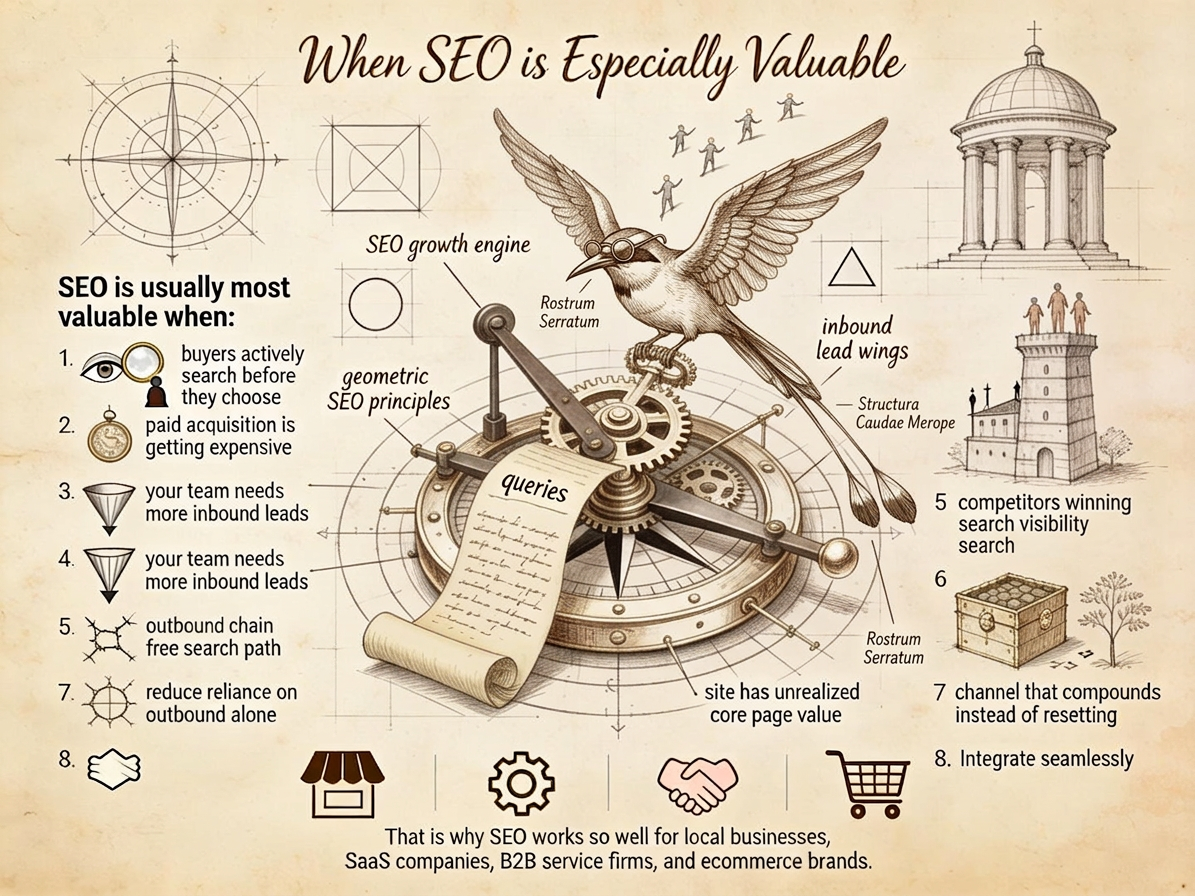
SEO tends to offer the greatest potential when customers actively search before purchasing.
It is especially useful when the business has valuable products or services, meaningful search demand, a website capable of converting visitors, and enough time to build organic visibility.
SEO may deserve higher priority when paid acquisition costs are rising, competitors dominate important searches, the company relies heavily on referrals, or existing website pages are underperforming.
The economics still matter.
A keyword with 1,000 monthly searches may be valuable for 1 company and irrelevant for another.
Traffic potential, conversion rate, average order value, lead value, close rate, gross margin, and customer lifetime value all affect the return SEO can create.
The objective should be business growth from organic search, not rankings in isolation.
Common misconceptions about the benefits of SEO
A lot of businesses hold back on SEO because they are working from outdated assumptions.
“SEO just means blog content”
No. Blog content can support SEO, but a lot of the real value comes from commercial pages, site structure, internal linking, technical fixes, and relevance-building around what the business actually sells.
“SEO takes too long to matter”
Bad SEO can drag on forever. Good SEO should create measurable traction far earlier than most people think, especially when the work is focused on meaningful pages and priority gaps first.
“SEO is only for big companies”
Not true. Smaller businesses often benefit even more when they choose focused opportunities and build around the right pages instead of trying to compete broadly from day one.
“SEO is mostly about traffic”
Traffic matters, but the real business value comes from relevant traffic, stronger commercial pages, better discovery, and more qualified opportunities entering the pipeline.
Frequently Asked Questions About the Benefits of SEO
What is the main benefit of SEO?
The main benefit of SEO is access to existing search demand. It helps potential customers find your business when they are actively researching problems, products, services, or providers related to what you sell.
Can SEO help your business grow?
SEO can support growth by increasing qualified organic visibility, generating leads or sales, expanding non-branded discovery, strengthening important website pages, and creating another customer acquisition channel.
The size of the opportunity depends on search demand, competition, your website, your offer, and your ability to convert organic visitors.
What are 5 major benefits of SEO?
5 major benefits of SEO are:
- attracting qualified organic traffic
- generating leads and sales
- increasing brand and non-branded visibility
- reducing reliance on paid acquisition
- creating website assets that can produce long-term value
What are the benefits of SEO for small businesses?
SEO can help small businesses reach customers with relevant purchase intent, improve local visibility, compete for specific services or geographic markets, generate calls and leads, and reduce dependence on advertising or referrals.
Why is SEO important for B2B businesses?
B2B buyers often research problems, vendors, services, pricing, comparisons, and implementation questions before speaking with sales.
SEO gives B2B companies opportunities to appear throughout that research process and turn relevant searches into qualified pipeline.
Is going viral good for SEO?
Going viral can create indirect SEO benefits when the attention leads to relevant backlinks, brand discovery, mentions, or people searching for the company later.
Virality alone does not create durable search rankings.
A short burst of traffic and a strong SEO asset solve different problems. The biggest SEO value comes when increased attention produces signals and assets that continue helping the website after the spike ends.
Why should a business hire an SEO agency?
An SEO agency can provide specialized expertise, additional execution capacity, technical support, content strategy, competitive research, and performance analysis.
Hiring an agency makes the most sense when the business has a meaningful organic search opportunity but lacks the resources or experience to pursue it internally.
The Business Value of SEO
The strongest benefit of SEO is its ability to connect customer demand with the right parts of your business.
That can mean a homeowner finding a service page and requesting an estimate.
It can mean a B2B buyer discovering a company during vendor research.
It can mean a software buyer finding a comparison page or an ecommerce customer discovering a product category.
Good SEO makes those connections easier to create and easier to scale.
Traffic and rankings remain useful measurements. Leads, bookings, sales, pipeline, and revenue tell you what the channel is actually worth.